
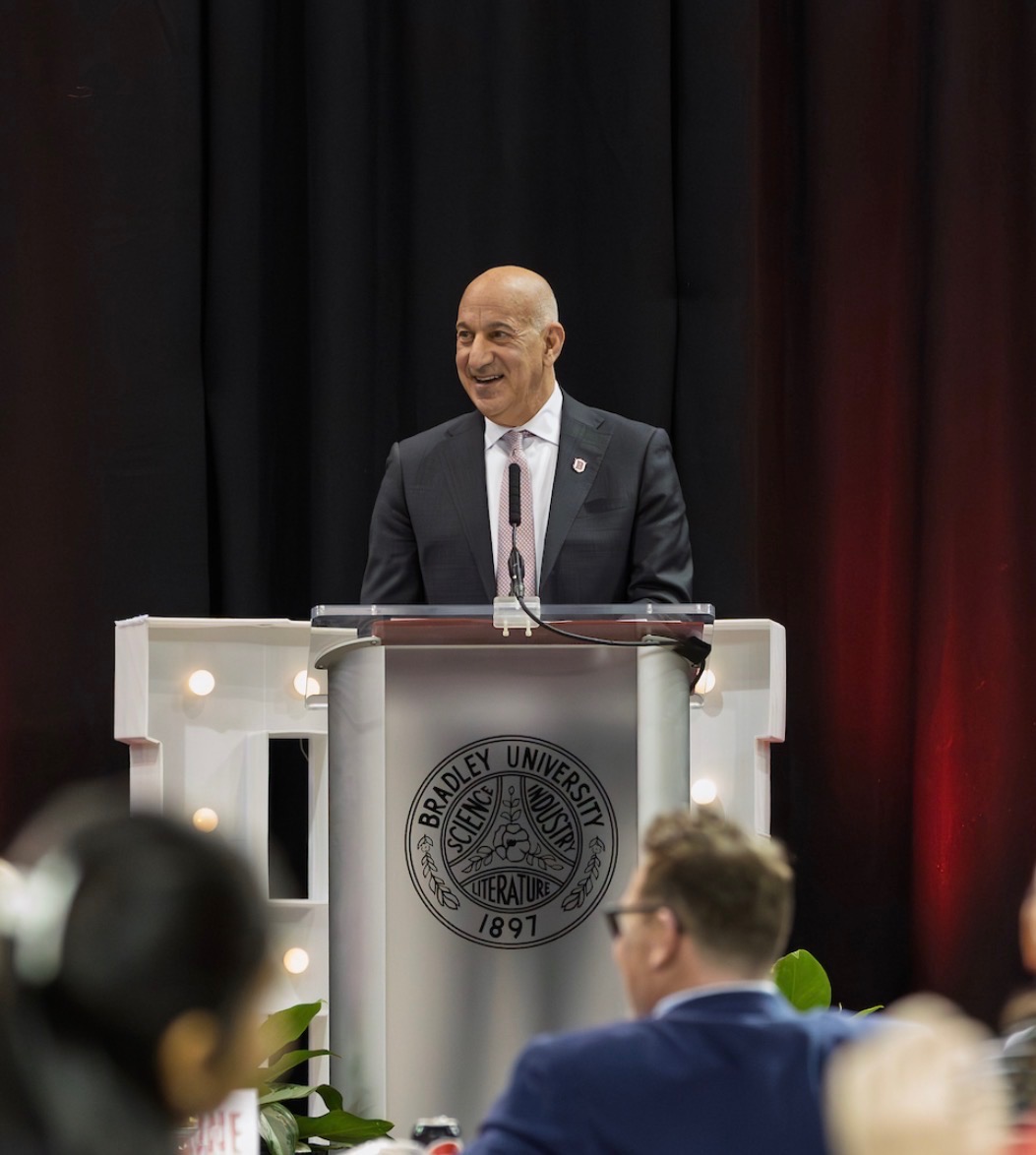
April 1 marks one year since James Shadid was made president of Bradley University. With that date swiftly approaching, Shadid sat down with The Bradley Scout to reflect on his time in the role and discuss his plans moving forward.
The following interview has been edited for conciseness and clarity.
Q: When you sat down with The Scout last March, you shared that your immediate priorities were increasing enrollment and stabilizing Bradley’s financial condition. How have these priorities evolved?
Shadid: They have evolved. We’re watching enrollment every day, and we’re encouraged for this coming fall. I’m going to stay cautiously optimistic, but I think admissions and the entire campus have joined forces. They understand that enrollment is all of our responsibility and doesn’t just rest at one place; it rests across campus, with faculty, with staff, administration, with deans, with everybody who is involved in the happiness, attraction and retention of students. Our campus visit days have been vibrant, and everybody’s played a role in that, so I’m encouraged.
Q: Recently, the Path2BU partnership with ICC was announced. Was that primarily established as a means of increasing enrollment?
Shadid: Yes. For many years, ICC students have transferred to Bradley. Somehow, over the last six to 10 years, these transfers to Bradley have reduced while transfers to ISU increased, and we want to reverse that, which the Path2BU will help achieve. It creates a seamless transition for ICC students to transfer to Bradley, aligning with my vision to attract and retain students, especially those from ICC.
Q: Can we look forward to any other partnerships within the community like this one with ICC?
Shadid: We can. We signed a partnership last week with DePaul Law School, creating a seamless transition for five of our students to attend DePaul Law. We also have relationships with the University of Illinois College of Medicine. We have established relationships with OSF and are building relationships outside Central Illinois with other community colleges. All of these are coming to fruition.
Q: Last semester, we had a few campus safety issues. What steps have you and the administration taken to prevent instances like these from occurring in the future?
Shadid: Immediately after the Geisert incident, I initiated a campus safety study. It’s taking longer than I had hoped, but we have a draft of it, and we’re going through it. We’re prioritizing measures such as cameras and card readers at entryways to enhance security and visibility across campus and in residence halls, as well as to keep out unauthorized individuals. We’re prioritizing campus safety; it’s a critical issue at the heart of the student experience. It’s at the top of our list.
Q: Since you assumed the role of president, what are the biggest challenges you’ve faced?
Shadid: My biggest challenge has been to create a culture of One Bradley. We’re all here for one reason. Everything we do must focus on improving the student experience, and we all have to be in this together to make that happen. Every organization, every department, every division that touches student life has to keep in mind that we’re here to serve you.
Q: Are there any ways the role of president has surprised you or been different from what you expected when you took it on?
Shadid: I don’t think so. I’m often asked what I like best about this job, and the answer is simple. For many years, as a federal judge, I watched young people make poor decisions every day. It’s really rewarding and impactful to walk around this campus and visit with young people like yourselves who are trying to make good decisions for themselves.
Q: What would you say success looks like for the university in the next year or so?
Shadid: I would say success for the university would be a continued One Bradley culture, continuing to attract and retain students who are enjoying their experience here. Success would mean retention rates increase, enrollment grows and our students have what they need inside and outside the classroom to prepare to be the people they want to be.
Q: What should students and staff feel most optimistic about right now?
Shadid: I hope they will be most optimistic about the ease with which we will be able to tell the story of this university. I envision a transformation of this university like no other. I’m very appreciative of the willingness of faculty and staff to help me move this university forward and, in doing so, elevate and enhance the experience we provide our students. That’s what I look forward to.

6 Responses
Having gone to school with Jimmy, graduated with him, kept his baseball stats, seen him at LCA parties and attended my Chi O woodsy with him as my date – I have known for years he was the only one who could right the Bradley ship, he is doing an amazing job and I am so proud to call him my President but most importantly my friend. Go Braves!!
I appreciate the update. I am encouraged by the focus and priorities being pursued by the president.
This is a great article. The future of Bradley is bright because of President Shadid’s leadership!
Sangamon college might also be a
link to Bradley…as I took classes from them while at Bradley.
The edited down version of the one-year anniversary with President Shadid did not provide much clarity on what once was, and maybe still is, a very concerning trend in enrollment and financial condition. When will we get more specifics as to whether the programs, cutbacks and such are working well enough?
Thank you for the comment. It is a good point. We’re scheduled to meet with President Shadid later in the year and will try to get more clarity on these issues.