
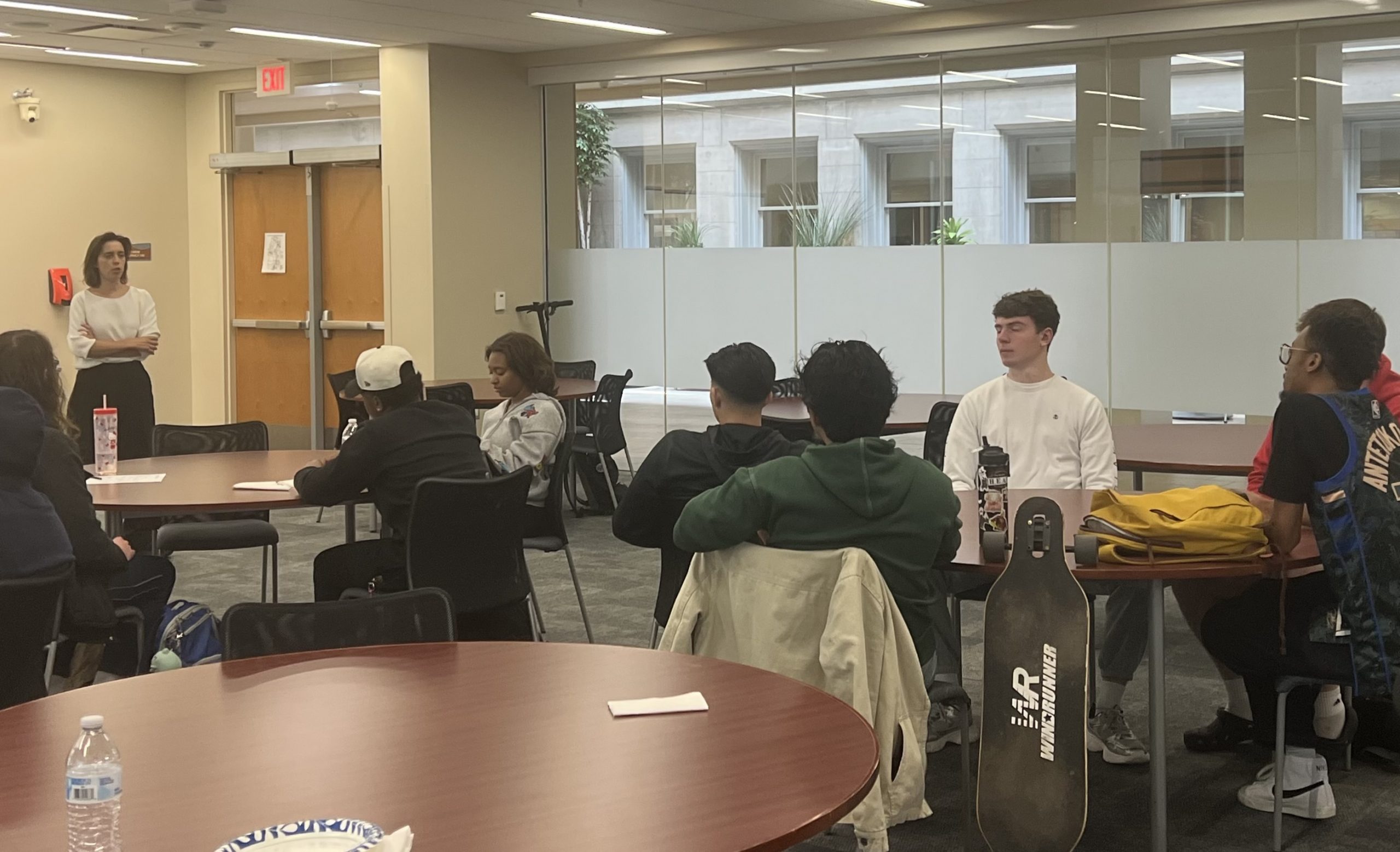
When author Lorissa Rinehart asked her audience of Bradley students who saw themselves as activists, hands stayed down and silence hung until she asked a follow-up question.
“Who here thinks that students have the power to create change?” Rinehart asked.
Despite the lack of raised hands, Rinehart stayed firm in her stance: those in the room had the greatest capacity to shake the system.
“It sounds cheesy, but you are actually the future. You are the ones who are gonna inherit this democracy, and you have the time and the energy to create that change, and you have the vision of what future you want to see,” Rinehart said. “So if we look back on history, every single time that major changes have been made in this country or any [country], it’s been students a lot of the time.”
This rings true at times in history, when circumstances seemed much bigger than modern frustrations in the US today. Tiananmen Square’s mass sit-ins, for example, were a movement cultivated by college students who opposed China’s stringent government.
And modern parallels continue to make headlines with students sitting on campus in tents to make a statement against the Palestinians’ suffering. Despite matching the profile of such active advocates as students, the Braves didn’t live up to their name—until Rinehart guided them through the steps of a successful campaign.
Having authored a book detailing the journey of Jeannette Rankin, the first woman to hold a seat in Congress, Rinehart’s account of Rankin’s movement between locomotives in her state of Montana sought to make one thing clear.
While Rankin had to hop from train to train to ask Montanans what issues they wanted addressed, students don’t have to go through that hassle and can go farther than she did without moving.
“Everyone has at least one social media that they could use that they’re looking at often,” senior communications major Jackson Glinton said. “You can reach people all over the world.”
With the issue of outreach in activism addressed, Rinehart increased students’ confidence further with a specific outline, calling it “the pillars of activism.”
“The first one is ‘know your terrain’: how are you going to research what’s going on? What’s the problem? The second pillar is ‘build unlikely coalitions’…then the third thing is ‘make the personal political’: How do you relate to this? Why is it important to you? Is there a story in your life that grounds it?” Rinehart explained.
“Because when we try to effect change, the best way to do that is to tell stories,” the author added. “Why? Because it’s not about anger or frustration.”
When given the tools, the Braves went to work on worksheets, and after the activity, the silent room was bustling with causes they wanted to boost.
Some were more immediate, related to concerns that arose after the US-Iran conflict.
“Everyone that’s sitting at this table is the prime age for a military draft, and we would be pretty affected if that was ever instituted,” senior high school history education major Branson Barth said. “Not that it seems like it’s going in that direction at this time, but any kind of war that would happen right now or within the next five years, we would be directly impacted, and that’s kind of our worrying concern about it in general.”
But with Rinehart’s guidance, it didn’t stop at anxiety.
“There’s definitely a lot of people on both sides of the political spectrum that are just generally anti-war, because they feel like it’s not benefiting the American people,” Barth noted after analyzing a hypothetical movement and a potential target group. “It’s generally going to benefit larger corporations with all the new technology that’s being purchased for the war. So you could definitely see radicals on both sides would probably come together and be pretty anti-war in this, I would say.”
While news of a possible war on the other side of the world spread, some issues are more closely tied to Bradley’s political management.
“In the previous election at Bradley, a lot of polling stations were at churches, and a lot of people with religious trauma might not want to go into those institutions,” Maggie Brunell, a senior majoring in hospitality management, said.
Additionally, it wasn’t just the sites of the polling stations that fell short.
“A lot of underclassmen want to get out and vote, but they just don’t know exactly how, because a lot of us, our education politically, has come from middle school and high school,” Brunell added. “We need a recap.”
For some, the issues that need advocacy aren’t about politics or tied to the news, but falling through the cracks.
“When I first found out about Bradley…I just saw all the ads about how they were advertising equity and how they had so many opportunities for everyone,” Aida McGee, a senior majoring in creative writing and English, said.
But even though Bradley has organizations that represent many on campus, for McGee, the pattern of exclusion was more intricate.
“I feel like with English Club, you see more white students than you see black students or any other person of color being involved in those types of clubs,” McGee noted. “I definitely think it’s more of a social thing with the students…I know the school is trying to even out the amount of students to be active. But I definitely feel like it’s more of a comfortability thing.”
While some issues raised are tied to larger conflicts that needed to be brought to Bradley’s attention or addressed, students raised their voices with Rinehart’s guidance, showing that when students have a grievance, they have the potential for activism.