
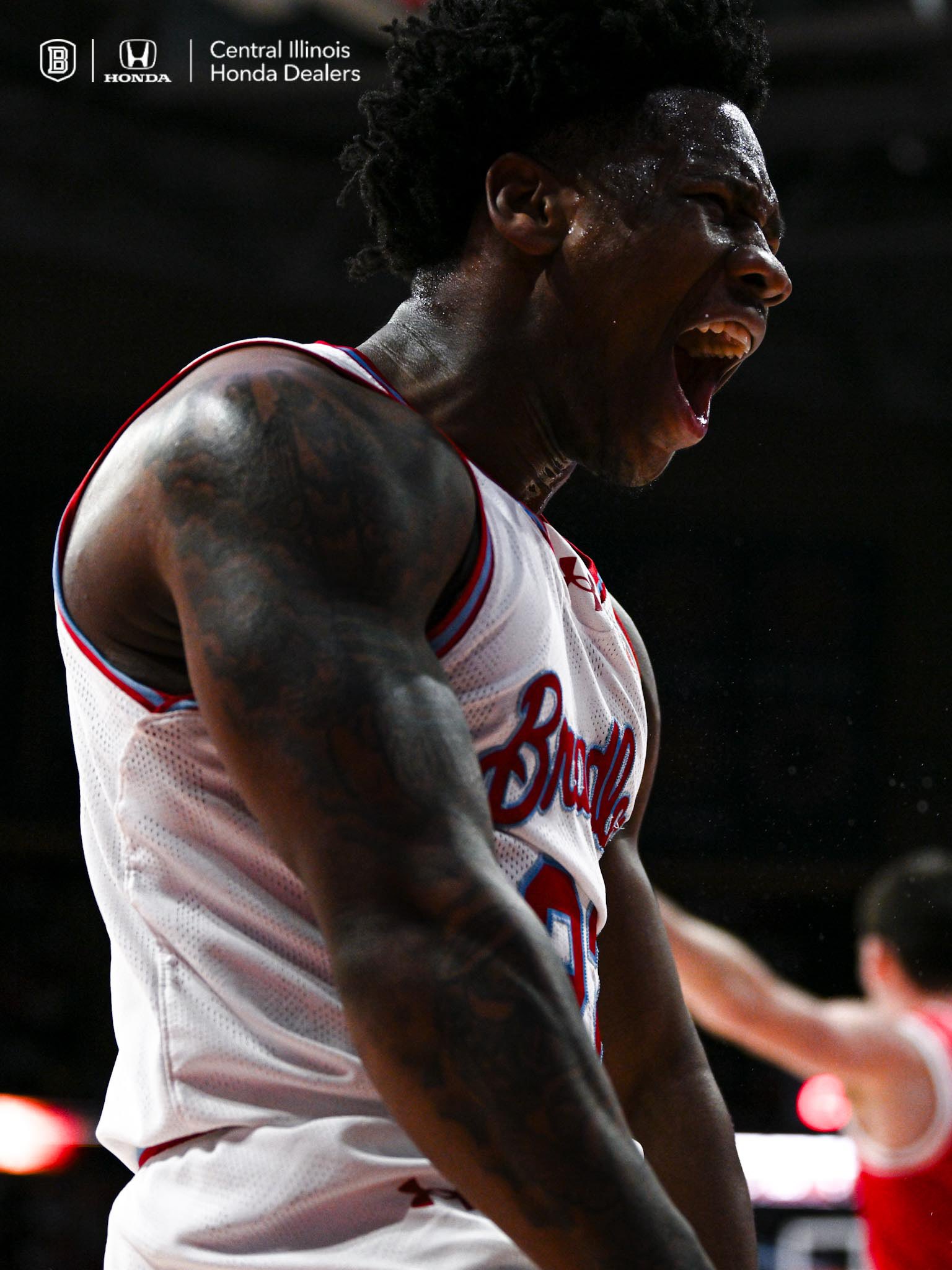
Tuesday, while I was working on a project, Bradley sophomore guard Jaquan Johnson walked into the Caterpillar Global Communications Center, commonly known as the GCC.
As he entered the building and noticed me sitting there, he did a customary head nod to essentially say, “What’s up?”
While he walked upstairs to his class, I asked him if he thought he’d win the Missouri Valley Conference Player of the Year.
He gave me a slight grin and simply said, “Yes, sir.”
He was confident in what he’d done this season, or maybe too trusting that a voting body comprised of coaches, sports information directors and media members would make the correct choice.
Early Wednesday morning, he’d receive the news that they’d snubbed him, instead opting to give the award to Belmont sharpshooter Tyler Lundblade.
This column isn’t meant to throw shade towards Lundblade; he’s a top-three shooter in the nation who warps defense, and the Bruins’ 91st-percentile offense is built around his strengths.
But Johnson was unequivocally better this season.
“Bully,” as his coaches and teammates affectionately call him, did just that this season — taking players’ lunch money, stuffing them into lockers and then running away with their possessions.
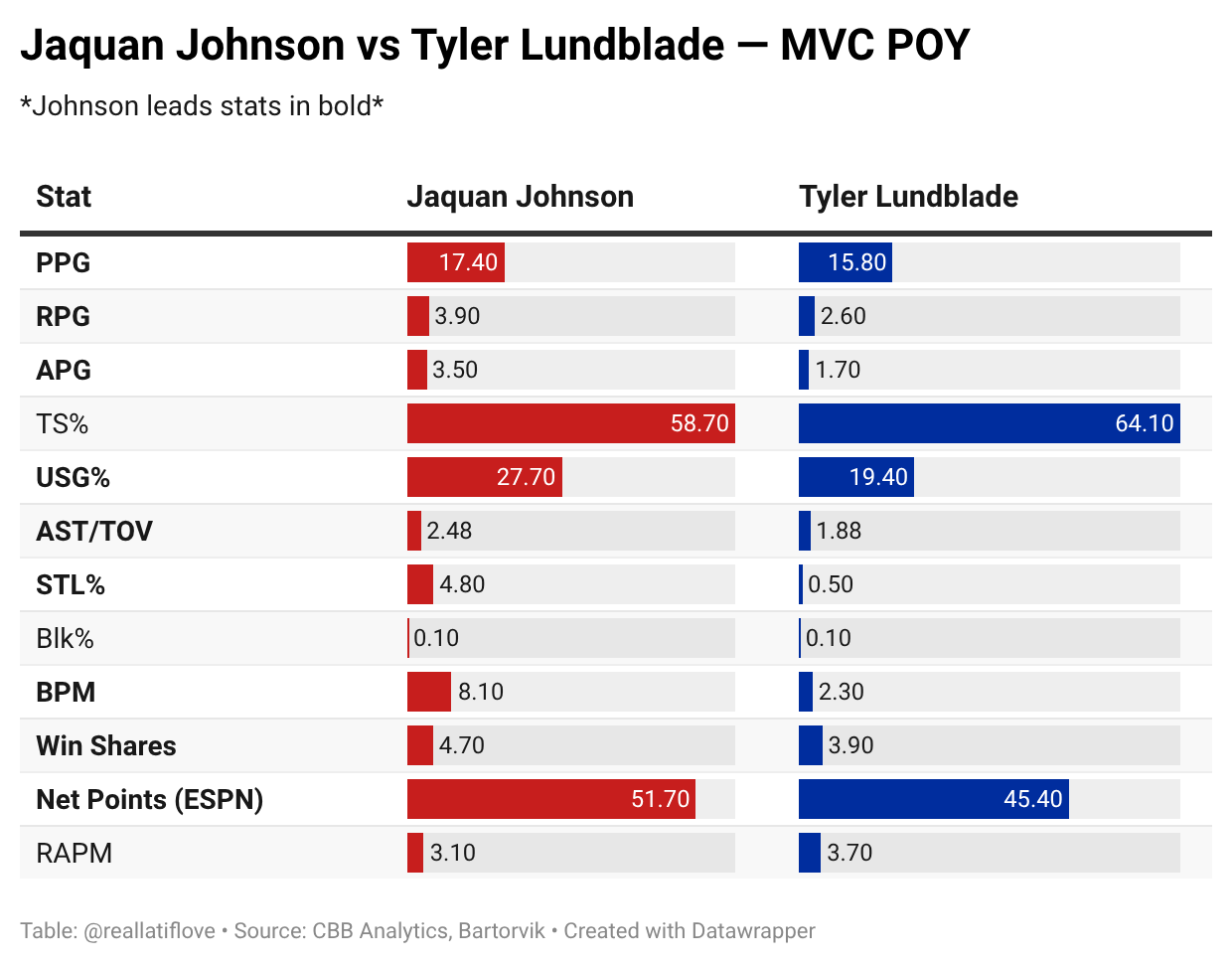
He averaged 17.4 points per game (second in the Valley), 3.5 assists (4th in the Valley) and led the league in steals by a sizeable margin.
Per CBB Analytics, Johnson was second in the league in points created, a stat that measures a player’s total offensive contribution by adding their points and assists, while also being the best defensive player in the conference, by the same voters’ own admission.
He led Lundblade in every major statistical category. He ranked higher in advanced statistics, including box plus-minus, win shares, ESPN’s total net points, and Evan Miya’s Bayesian Performance rating (BPR).
Johnson was integral to a team that was thought to be in a rebuilding season after losing four of its five starters and three all-conference players, yet ended the regular season as the MVC’s second-ranked team. The Braves were 13.3 points better per 100 possessions with him on the court compared to when he was off.
If you’re not into advanced analytics, think about it holistically.
How could a player who only significantly affects the game as a shooter — albeit one of the best in the country and incredibly impactful to Belmont’s offense — be a better player than someone who scores, defends and makes plays at a higher level with higher usage?
On top of a significant difference in usage, their creation burden was completely different this season. 82.9 percent of Lunblade’s scoring production was assisted in comparison to 27.2 percent for Johnson.
It’s picking a specialist over a do-it-all player.
Johnson wasn’t just Bradley’s leading scorer. He was their primary initiator, their best perimeter defender and the tone-setter for a team that many expected to spend this season figuring things out rather than competing near the top of the league. Possession after possession, he dictated the game on both ends of the floor.
Lundblade, meanwhile, is an elite weapon — but a weapon with one function.
Johnson is a bayonet.
That distinction matters.
The decision reeks of low effort, but it shouldn’t be surprising coming from a league that released a preseason watch list bloated with 39 players instead of taking the time to narrow things down to a 15-player preseason all-conference team.
Rather than making tough evaluations, it felt like the conference simply cast the widest possible net.
This vote felt similar.
It feels as if the voters defaulted to the easiest narrative: best player on the best team.
Except that the team is loaded with talent.
The Bruins had three All-Conference selections, two All-Defensive team selections and two All-Freshman team selections. They’re a juggernaut, a deep and well-balanced roster led by an excellent coach that can beat you in a variety of ways.
And because of that, their best offensive player is often given more credit than he probably deserves for the machine’s success.
Lundable and the Bruins were great this season — no one is disputing that.
But when it comes to identifying the most valuable player in the Missouri Valley Conference, the conversation shouldn’t start and end with the team that finished first in the standings or with what a player does on one side of the ball.
It should center on the player who most consistently impacted winning across the board.
That player was Jaquan Johnson.