
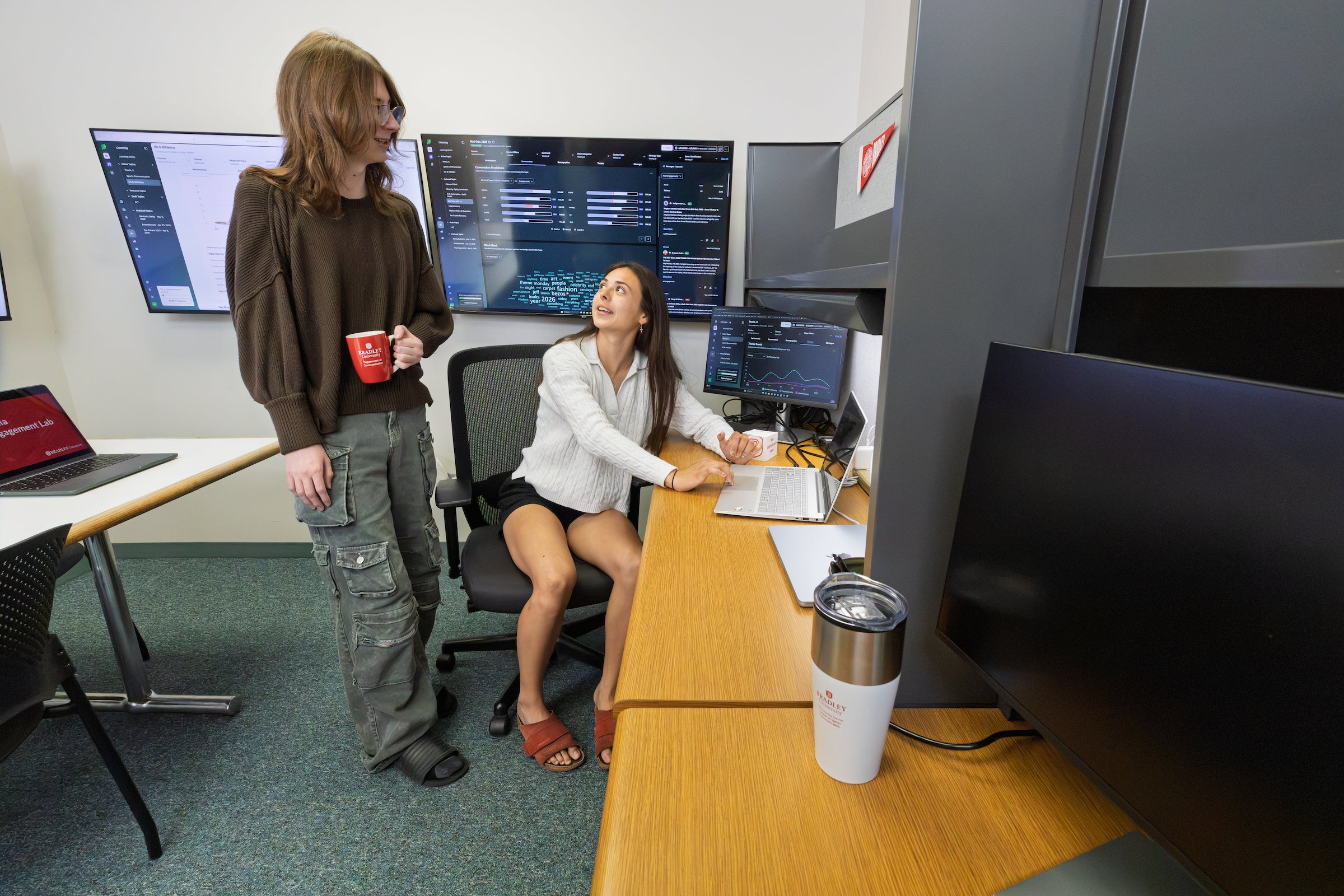
One of the best feelings for a professor is watching their students’ confidence grow.
That’s what Sara Erlichman, an assistant professor of communication and director of the Media Engagement Lab (MEL) said.
In spring 2026, under Erlichman’s direction, the MEL was soft-launched and piloted in a few courses on campus. MEL was officially launched on Sept. 17, located in the Global Communications Center.
The idea is that the MEL will give students hands-on experience with the analytical tools and workflows of today’s industries.
“We give students access to industry-standard analytics tools so they can turn emerging trends into insights they can act on,” Erlichman said. “It brings to campus a bridge between the classroom and the workplace. Instead of just learning about analytics, students actually do analytics.”
The concept for the MEL arose when Erlichman was working in the analytics department at a global communications consultancy.
”I recognized a gap between the research taught in academia and the industry in higher education curricula,” Erlichman said. “Most organizations use analytics platforms, but very few students get exposure to practicing analysis and drawing insights from them before entering the job market.”
The MEL makes this work possible through a contract with Sprout Social, a professional social media management and social listening platform. Through Sprout Social, students can build queries surrounding specific topics, brands and conversations, and then take that information and analyze it to see how and why it’s trending.
But that’s not all.
According to Erlichman, students are able to engage with the MEL in three different ways: upcoming workshops and events, student staff members who run demos and support projects and classroom integration.
In fact, Erlichman believes that is the MEL’s most important job.
She explained that the MEL works directly with faculty to design activities and assignments specifically made for their course’s learning objectives.
“Faculty don’t have to become analytics experts or buy the software themselves,” Erlichman said. “We help co-design the activity and support it. The lab can also support faculty research in media analytics.”
Looking forward, the longer-term goal for the MEL is to make it a resource accessible to the entire university, not just the communication department.
“We want to expand our toolset and our workshops and show measurable impact on students’ education and career readiness,” Erlichman said. “The bigger vision is for Bradley students to graduate with analytical skills, a strategic mindset and hands-on experience that set them apart.”
The MEL also hopes to work with other colleges and universities in the future to further expand their reach.
Most importantly, the MEL is dedicated to empowering students with the knowledge and skills they need to succeed after graduation.
“Data can feel intimidating, especially for communication students who don’t think of themselves as numbers people,” Erlichman said. “When a student builds their first query, sees real conversations come through and finds an insight nobody handed them, that’s a powerful moment.”
“They leave knowing they can do this, and that confidence goes with them into interviews, internships and careers.”