
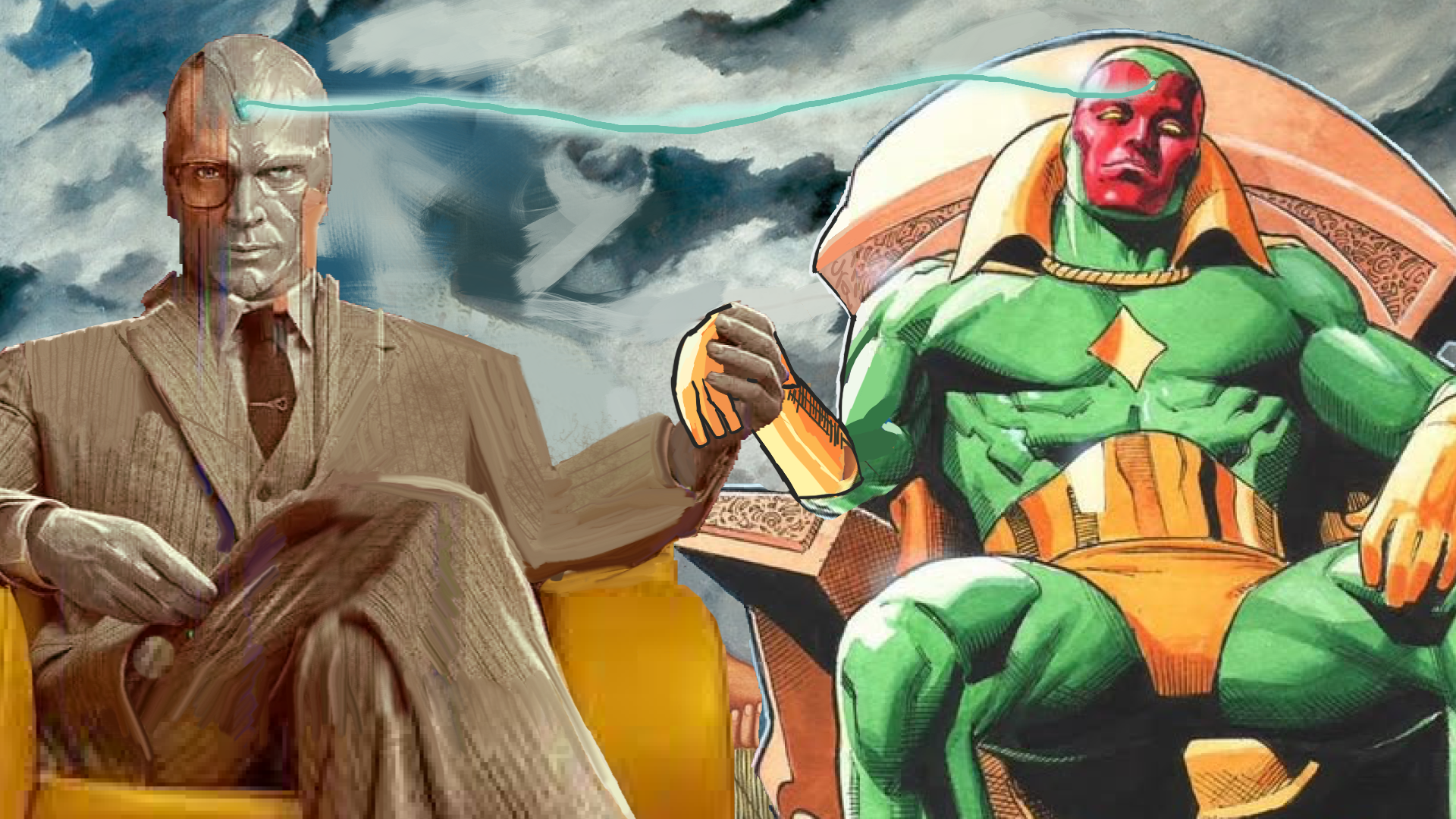
This review contains spoilers for “VisionQuest” (2026)
It’s not easy to find yourself, especially after being rebuilt multiple times.
The hardest part of this quest is accepting you weren’t really lost.
That is the main idea behind Marvel Studios’ “VisionQuest,” a series exploring identity, humanity and the complicated process of continuing forward, with or without one’s loved ones. Rather than relying on the usual superhero series, this one presents a surprisingly personal story about family, romance and self-discovery.
The final installment of Marvel’s “WandaVision” television trilogy is not only one of the studio’s strongest miniseries projects, but one of its most thought-provoking.
The Ship of Theseus
The series explores an interesting philosophical question: the Ship of Theseus paradox. If every part of a ship is gradually replaced, does it remain the same ship?
“VisionQuest” takes that question a step further, applying it to one of the MCU’s most complicated characters.
Rebuilt into a weapon with the memories and experiences of his predecessor, Vision (Paul Bettany) spends much of the series struggling to accept his identity, refusing to admit that the identity he respects and places on a pedestal is him at all. Despite possessing the memories and emotions of the original Vision, he repeatedly denies that they’re one and the same.
His struggle is not necessarily about discovering who he was, but about accepting who he already is.
I think this is what makes his character development so compelling. Vision views his predecessor as an idealized version of himself. However, his journey eventually forces him to recognize that his previous identity was never something he needed to overcome, only embrace.
People change.
Experiences will influence their personality, their connections and how they view things. However, becoming a new person does not mean leaving the old self behind entirely.
The acceptance by Vision that he can have two identities – his old self and the one that has been remade – makes the whole Ship of Theseus concept more compelling.
It becomes the cornerstone of his entire character development.
Finding the human in the machine
Even though Vision is entirely artificial intelligence, his path has a very human element to it.
From the start of his story in “Avengers: Age of Ultron,” Vision displays a deep understanding of emotions and feelings.
Everything the viewer sees in “VisionQuest” – family, love and personal relationships – makes the philosophical aspect of the show deeply emotional and is further strengthened by a complex relationship between Vision and the many versions of himself. It proves that identity is connected not only to memories and looks, but also to the relationships we create throughout our lives.
It is extremely fascinating to see the dynamic between Vision and Ultron (James Spader) develop.
They both came from the same origin, but their views of humanity and life couldn’t be more different.
Ultron tries to prove Vision wrong about his self-perception, making him aware of aspects of his identity he doesn’t want to confront, and that problem grows with the introduction of Vision’s son, Thomas Shephard (Ruaridh Mollica).
The dialogue between Vision and Ultron is among the most compelling parts of the series, because it explores the difference between personal growth and repeating past mistakes.
“VisionQuest” even went as far as to introduce Jim Hammond, the first-ever superhero created by Marvel, to shake Vision’s ideas and make sure viewers see the challenges Vision is undergoing firsthand.
The strength of this series is in its ability to make abstract conversations feel grounded. I was more invested in the characters’ emotional lives than in the plot around them.
“VisionQuest” knows that perfection is not the goal of humanity – the goal is to experience, to learn and to accept that we are always changing.
“VisionQuest” post-credit scene
While “VisionQuest” delivers a satisfying conclusion to Vision’s personal journey, its post-credit scene reminds audiences that the MCU’s larger story is far from over.
After years of uncertainty about Wanda Maximoff’s (Elizabeth Olsen) fate following “Doctor Strange in the Multiverse of Madness,” Marvel Studios finally confirms that the Scarlet Witch is alive. However, her return comes at a cost: Doctor Doom (Robert Downey Jr.) intends to claim her power, as he retrieves her from the mountain viewers saw her get crushed by in her prior appearance.
This is an especially exciting development heading into “Avengers: Doomsday.”
Rather than simply introducing another powerful villain, Marvel presents someone who appears capable of turning its most dangerous heroes into pieces of his own plan.
It is an effective reminder of how terrifying a villain can be when the audience understands the power of the person standing against them.
Vision’s journey
Marvel has spent years releasing movies and different television series about saving the world. With “VisionQuest,” it tells a story about saving something much closer to home: one’s sense of self.
“VisionQuest” succeeds because it understands that finding yourself isn’t always about becoming something new. It can mean accepting the person you have always been, even when circumstances make that difficult.
Vision’s journey hints that our past doesn’t have to dictate our future, but it should never be something we feel obligated to erase.
That’s what makes the series so personable. Beneath its superheroes and science fiction is a story about something everyone experiences: trying to understand who we are while putting one foot in front of the other.