
Is a crisp $20 bill worth as much as a crumpled-up $20 bill? Just like crumpled money, mental health doesn’t change a person’s worth, according to Bradley guest mental health expert Latrice Drain.
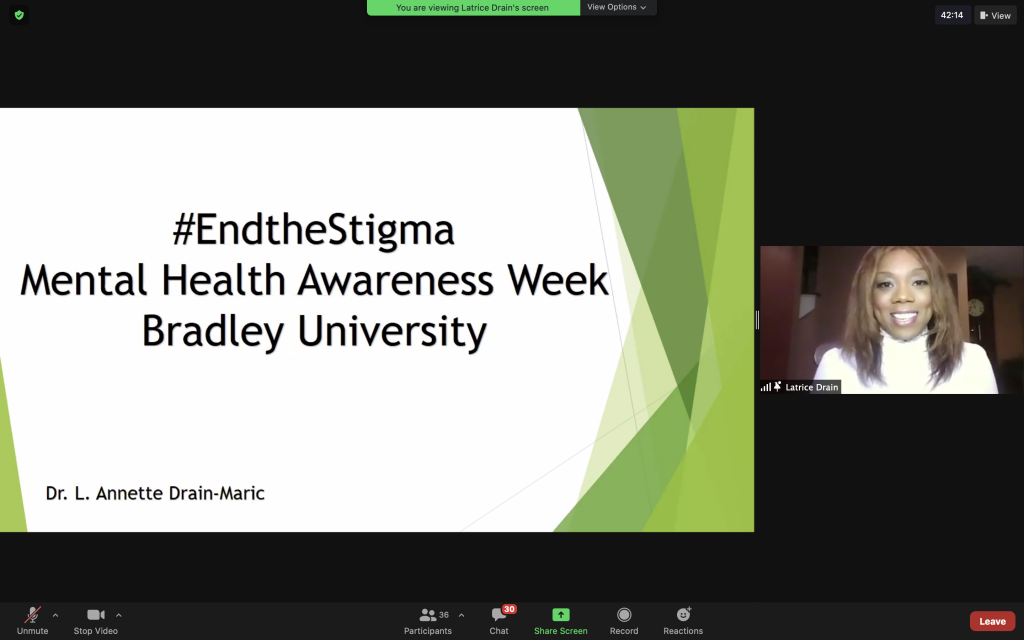
Bradley Multicultural Association of Pre-health Students (MAPS), along with the Bradley NAACP, Association of Latin American Students, Black Student Alliance and Active Minds, hosted Drain on Oct. 6 for the #EndtheStigma event, a presentation on mental health and how it is perceived.
Drain is an international psychologist in private practice, has been an educator for 10 years at various universities, an author of several published works on mental health and speaks regularly to student groups.
She started the Zoom presentation with a $20 bill by asking what its value is. She then crumpled it up and asked again what it was worth. She concluded that’s how people are: regardless of what someone has been through, mental health does not determine worth.
October is Mental Health Awareness Month, and this past week MAPS hosted Mental Health Awareness Week. The secretary of MAPS, junior psychology major Jahne Manifold, said Drain was chosen as the event’s speaker because of her focus on mental health in young adults.
“There was no specific mental health disorder that our club wanted to focus on with this event, rather we wanted students to recognize when their mental health is being challenged and ways to get help for mental health,” Manifold said in an email interview.
Drain emphasized making sure that people not only check their own mental health, but respectfully check-in and take care of others. She explained the harmful effects of toxic positivity, when one person uses words of encouragement to support another, but fails to validate another’s emotions.
“I felt that [the presentation] was really well done,” said junior television arts major Madison Pratt. “I really liked the speaker … some of the tips were useful, I had heard a lot of it before, but I had really never gotten a definition on toxic positivity, and she gave me a definition.”
In order to control mood, Drain suggested writing down three items indicative of gratitude and then write down one to three actions to do when feeling overwhelmed.
She also reminded everyone to recognize how they are feeling, limit what is bothering them and share their thoughts and feelings with someone close to them.
Manifold said gaining knowledge and defining mental health concepts can challenge mental health stigmas.
“If we know of what takes place in specific mental health disorders, we can be more compassionate for those who experience them,” Manifold said.
Pratt said she thinks there needs to be more emphasis on mental health, even when there isn’t a pandemic.
“I think it is even more important now that we are in a pandemic and we really aren’t supposed to leave out [of our] houses, it is emphasized more in our lifetimes than it ever has been, which is good, as long as it is done correctly,” Pratt said.
Manifold said social distancing and avoiding social interaction can certainly stifle communicating mental health problems.
“It can be hard for everyone to find a balance of how to continue to communicate well,” Manifold said. “Not only that, but after prolonged confinement in dorms, houses, and other living areas, it is no doubt that we have lost some of our social outlets.”
Bradley MAPS will be handing out green ribbons to support mental health awareness today from 11 a.m. to 3 p.m in the Pride Circle. To contact Bradley MAPS, email them at bradleymaps1@gmail.com.