
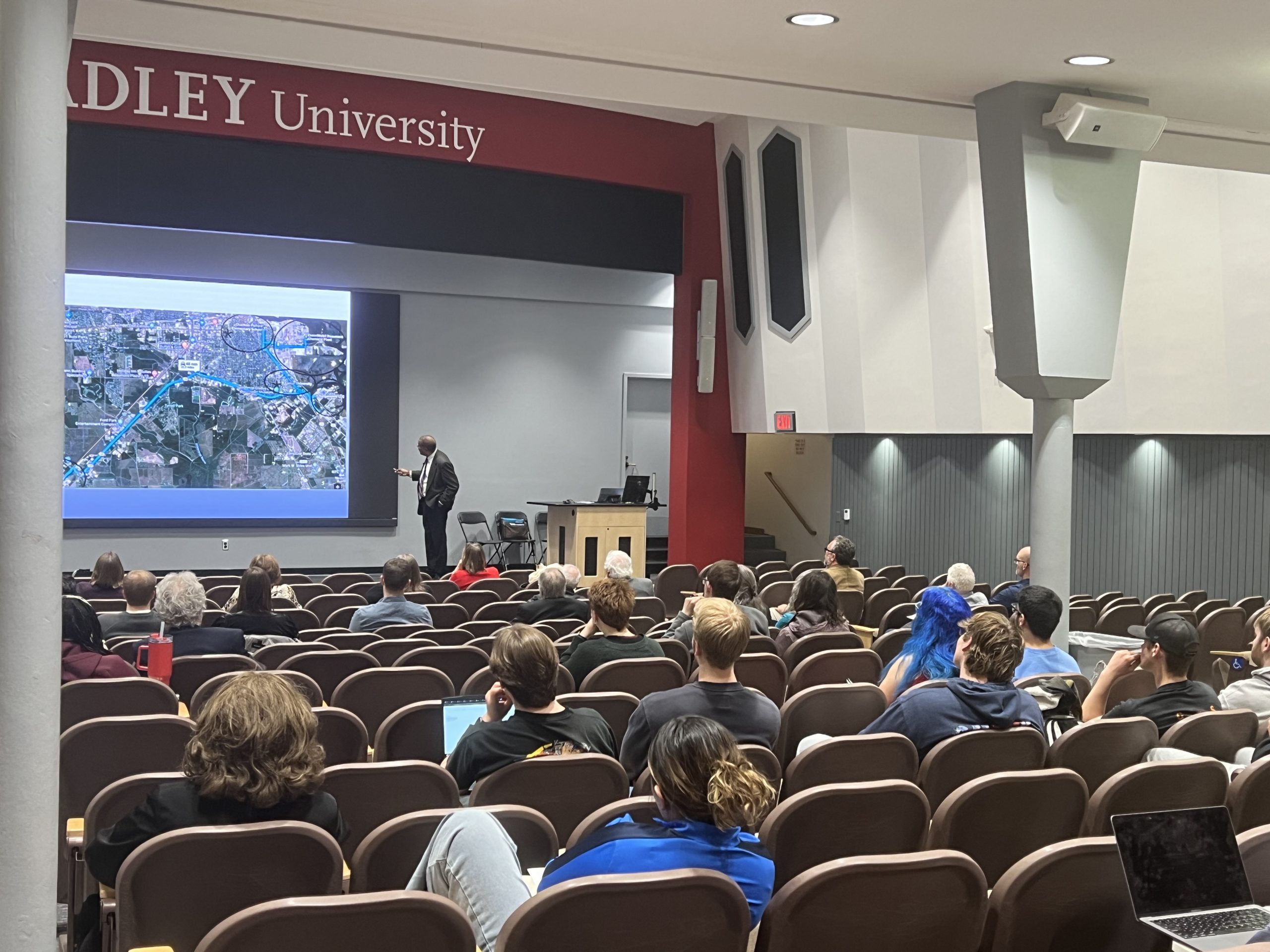
Over halfway into Black History Month, Bradley held its annual lecture honoring the legacy of its groundbreaking alumni and first-selected black astronaut, Major Robert H. Lawrence Jr.
This year, the campus hosted former president of the American Chemical Society (ACS) and chemistry professor at the University of Pennsylvania, Joseph S. Francisco, to speak on his research on acid rain formation – and what it could mean for future generations.
But Francisco’s journey to becoming the president of the ACS was not without challenges.
Growing up in the ‘70s, redlining and the barrier of segregation held many back. But for Francisco, it meant he wasn’t allowed to cross the railroad.
“So I said, ‘Well, I won’t cross over the wood tracks,’” Francisco recounted. “But I was on the tracks, and there was a lot of interesting chemistry there.”
Yet, despite societal barriers, Francisco’s biggest setback was personal.
His early curiosity led him to libraries and to asking questions of his high school teachers. Those teachers then decided to push him onto the path that led him to Bradley.
“My high school physics teacher and my high school chemistry teacher, they applied to the University of Texas on my behalf,” Francisco said. “My grandparents signed all the papers, and I got a call from Texas, [letting me] know that I had been admitted … I saw it and said, ‘I could start tomorrow.’”
At the university, Francisco’s curiosity didn’t end when classes did. The fog that filled the campus became his next mystery.
“There was something that struck me as odd. Whenever there was a foggy day, [the female students] did not want to leave the student union and go to class,” Francisco explained. “And one of the reasons was … if they were wearing [scarves or] silk stockings, by the time they got to that class, there were holes in the scarf [and some] reported that the silk stockings had melted on their skin.”
After presenting the issue to those in attendance, Francisco explained acid rain, the suspected culprit behind the mysterious fog. With the two sources of acid rain being common – automobile exhaust and nitric acid – it wasn’t an unlikely assumption. However, the science at the time was against this hypothesis.
“[Acid rain formation] takes 13 days, and it didn’t make sense to me as a kid growing up in Texas,” Francisco said.
Since the women at his university weren’t standing in the fog for that long, Francisco did additional research into how long the formation of the acidic substance really took.
“[The time] generating the sulfuric acid rain is not 13 days,” the professor concluded. “But 13 seconds.”
Having solved the mystery, Francisco continued to consider the ramifications of his results.
“[In] geo-engineering, we need the solution to cool the planet down [with a] temporary solution,” Francisco added. “And what are the suggestions? Let’s take SO2 and put it up in the stratosphere and let it react with the water to [trigger the] traditional acid brain mechanism and reflect off radiation.”
His findings, suggesting sunlight played a role in taking acid rain formation down to seconds, prompted reflection at the end of the lecture.
Those like senior mechanical engineering major Sam Hahn found the industrial consequences of chemical reactions particularly relevant.
“I’ve worked in chemical engineering places before, so, you know, being aware of how to mitigate some of the causal factors of acid rain is interesting,” Hahn said. “It potentially could have implications for me.”
Beyond inspiring current Bradley students, Francisco has experience with alumni as well. After Bradley, Simone Aloisio, the associate vice provost for academic personnel at California Polytechnic State University, was a student of the professor’s at Purdue University.
“Dr. Francisco taught me how to ‘respect the science’ and taught me how to be part of the chemistry community,” Aloisio said. “We have to … make sure that anything we put out there with our names on it is as solid as it can be.”
“I really appreciate the education that I got here at Bradley, especially since I wasn’t the best student in the world,” Aloisio added. “But, you know, Bradley met me where I was and was able to help bring me up to the level where I can go and be a graduate student.”
That experience helped encourage the professor to present the lecture at Bradley.
“Because one of my first graduate students [graduated] from here, I always wanted to kind of see the university,” Francisco said. “Because [Aloisio’s] a great student, I want to see: what’s that university producing students like that? I want more.”
Through acid rain, research and industry reflection, this year’s Robert H. Lawrence Jr. lecture both inspired curiosity and satisfied it.