
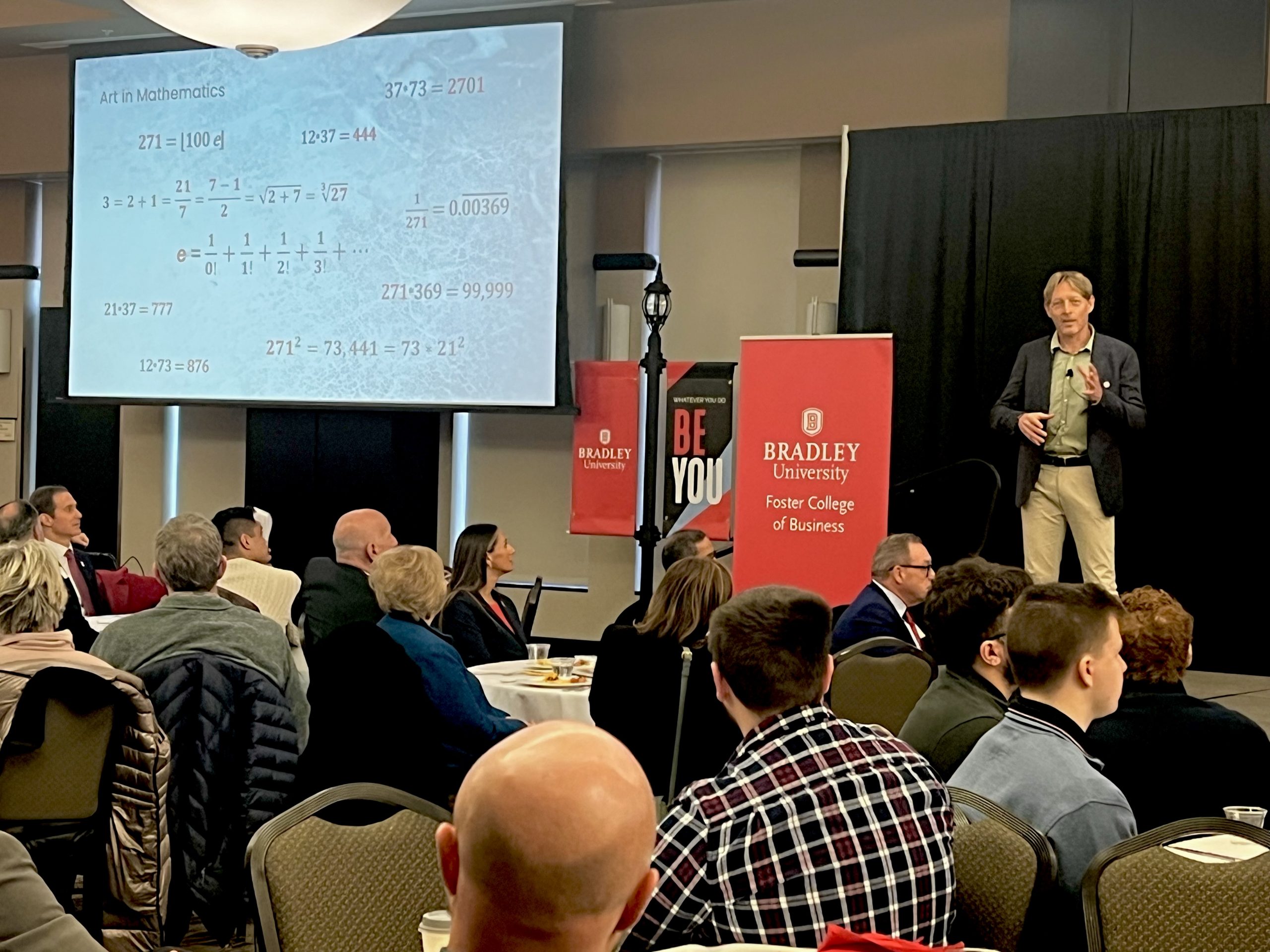
Despite being held every year, the McCord lecture series never looks the same.
Funded by the McCord family, it has spanned almost 50 years and featured many speakers, but what remains constant is the drive behind it.
“[My grandfather] had given a lot of years of service to Bradley University and really believed in the university’s impact on the community,” Katie McCord Jenkins, president of the Illinois Mutual Life Insurance Company, explained. “And so our company made a donation in his honor at his retirement.”
Bradley’s impact continued with the 48th lecture, bringing alumnus Karel Janeček. Janeček was born in the Czech Republic, found Bradley through a stipend and now speaks on gambling, politics and art, but one thing connects everything for him: numbers.
But it doesn’t stop at theoretical connections for Janeček. Besides using his understanding of patterns to bypass blackjack apps, he also found his way into his businesses until he was banned.
“Instead of 250,000 in checks, I will [put] 12 to the fifth power,” Janeček admitted. “It turned out to be great marketing too, because people would see this foundation price, and the price is to the fifth power … There’s this effect of attention.”
After threading personal experiences with the natural patterns found in math – identifying “aesthetic numbers” – Janeček gave the audience something to consider.
“If we manage, as collective human beings, to support each other, we will for sure find other civilizations,” Janeček said, hinting at the possibility of aliens. “And my conjecture would be that other intelligent beings in the universe will also have 10 fingers.”
While Janeček entertained the idea of seeing more inherent patterns beyond Earth, some found room for disagreement.
“I think we use [our number system] because we have 10 fingers; if we only had eight, we’d use base eight,” Professor of Mathematics Mathew Timm contended.
“So I really think that mathematics is a human construct, and we’re not going to construct something that doesn’t make sense to us,” Timm said. “[Janeček] did what mathematicians frequently do; he noticed his coincidence and used that to define a collection of problems.”
For those more interested in how Janeček uses patterns, the lecture stood out for different reasons.
“[Janeček] has his hedge fund he’s got going on and [he’s] a billionaire, so he knows money pretty well. We think he might have some valuable insights for [the AI club’s] portfolio,” Spencer Schwalb, vice president of the AI club and sophomore in management information systems, said. “It’s kind of similar to what I do with data analytics, because it’s about finding those patterns and the numbers.”
Numbers brought together a room of those looking for significance and answers, but others like senior political science major Al Cuizon, Jr. found connections to something else entirely.
“A lot of what we [catholics] talk about is how perceived coincidences aren’t really coincidences in a sense,” Cuizon, Jr. said. “For example, there are 12 apostles, and the number 12 is significant in mathematics, as we saw today.”
With the many perspectives Janeček’s lecture on the art in mathematics inspired, his life as a political activist and former presidential hopeful in the Czech Republic also caught attention.
“In particular, [Janeček’s] connection with mathematics … and how that relates to God and spirituality … helps you understand how to move forward in life as a whole,” Cuizon, Jr. added. “Hence his development of anti-corruption campaigns and influencing other students to do the same. I plan on building things like that along with collaborating with him in the future.”
Even though it wasn’t the highlight of his presence at Bradley, Janeček’s political contributions have impacted several organizations that adopted his ‘D21’ voting system, in which voters can vote for multiple candidates and even have a ‘negative vote’ – subtracting from a least favorite candidate.
“It’s not the case here, but it is in Europe; it can easily have a candidate that wins that’s not liked by the others,” Janeček explained. “Because imagine that you have 20 percent of people supporting one extreme candidate while the other 79 percent of people are supporting other candidates, but they’re splitting by voting for different candidates.”
While politics, finance and the art of patterns attract different audiences, Janeček’s eye for numbers tied them all under the equation of mathematics – and connection with others.