
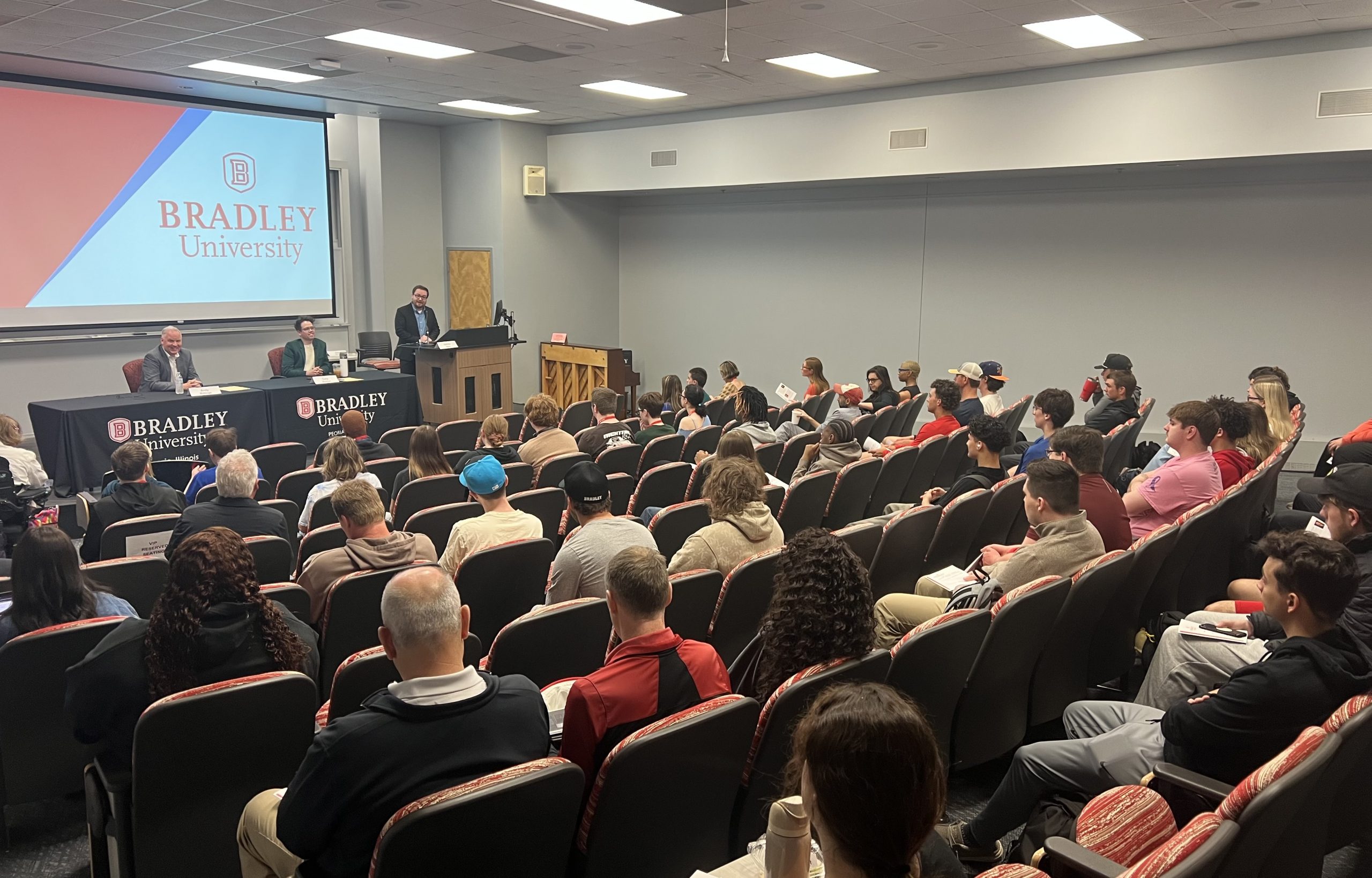
Sports events usually gather cheering fans into stadiums, but on April 9, the Caterpillar Global Communication Center’s (GCC) auditorium was filled with sports enthusiasts who are in it for the love of the game.
Depending on what aspect of sports one is interested in, the game could look very different, so the ninth annual Steiner Symposium was broken into four fields: streaming services, building brands, NIL (name, image and likeness) – alongside the transfer portal and sports analytics.
To kick off the event, professor and associate chair of the sports communication department, Joshua Dickhaus, introduced the room of Braves and visiting high school students to the first panelists after playing Charley Steiner’s video addressing the room.
“This is the ninth symposium, the first was back in 2015. The late Larry King, a dear friend of mine, opened the show for business,” Steiner, the notable ‘71 alumni and namesake of the symposium, said. “Larry and I would have a lengthy discussion. We would discuss trending [topics] in sports communication. Where were we headed? We didn’t know.”
Sports communication has changed drastically in the 55 years since Steiner’s graduation, but Bradley is accommodating for that.
Delaney Giles, a senior sports communication major who has attended multiple symposiums, noted the changes throughout the years.
“I really like that every year the panels are different. I know last year there was an analytics panel, but it focused a lot on AI, so it’s cool to see. You know, that was a very relevant topic last year,” Giles said.
Living rooms are the new stadiums
There are two ways to watch sports in the 21st century: a ticket and going to the game or streaming the match on TV.
The symposium began with associate professor of communication Dakota Horn moderating a panel featuring Andrew Billings, the associate dean for faculty in the College of Communication and Information Sciences at the University of Alabama, and Cory Barker, an assistant teaching professor in the Bellisario College of Communications at Penn State.
While streaming is now a prominent part of sports consumption, Billings offered a different perspective.
“One of the big appeals of streams is you can watch what you want when you want to, but one of the big appeals of sports is you have to watch it now,” Billings noted.
While Barker acknowledged that perspective, he added that streaming also provides a new, less profitable avenue for watching games: piracy.
Both emphasized that money is a motivating factor in many sports decisions, but Barker argued that piracy might not drive away sports fans’ loyalty.
“Historically, a lot of studies related to piracy as a whole have underlined that folks who pirate media the most are the heaviest media consumers,” Barker explained.
Even if they don’t watch every game legally, they might eventually want to spend a heavy sum on a ticket to see the team they support.
Being a shiny brand isn’t all it takes
Branding is a popular topic in many fields with companies dedicating resources to ensure their marketing is memorable and unique. However, panelists took this tried-and-true approach to the next level, emphasizing consistency above all else.
“Consistency doesn’t mean it’s identical for everyone,” panelist Isabelle Broughton, the marketing director at RC Outfitters, said. “It’s the same ‘feeling’ across different brands. And I see that in how I manage different companies and their social media experiences. Some of our programs just try to make sure everyone truly understands the foundation of all our businesses. And making sure [of that] helps keep everything consistent and keep that same magical feeling throughout the brand.”
To connect the concept back to sports, Kris Peterson – panelist and vice president of communications and content for FC Cincinnati – highlighted the reason behind the importance of undeniable branding.
“I think brand voice and value are what have to be at the forefront,” Peterson said. “To be consistent is the biggest thing, because you want your fans, whether it’s looking at social media, being in a venue, whatever it is … You want them to be able to say, ‘Oh, that’s FC Cincinnati,’ without even thinking about it.”
Athletes’ Name, Image and Likeness is theirs
Not everything is fun and games in sports, and athletes’ rights are at the top of the industry’s concerns.
NIL, while it may seem like a new issue amid the heap of privacy breaches on the internet, has actually been a concept for decades, with concerns emerging in the ‘90s from NCAA athletes.
Many attribute NIL’s prominence in conversations around sports and rights to the 2021 Supreme Court case Alston v. NCAA – in which the Supreme Court allowed student-athletes to monetize their own NIL. Panelist and trial litigator Mitch Gilfillan expanded on the choices athletes often face with a scenario.
“A guy by the name of Shawne Alston in 2014 challenged the NCAA. He was a West Virginia running back who challenged the NCAA and said ‘Why do we not receive any benefits for laptops, graduate programs and travel abroad?’ We believe the NCAA is restricting our educational benefits, and therefore we should be getting paid or compensated,’” Gilfillan said. “So now student-athletes get five to seven thousand dollars per semester just in Alston payments.”
Even with the win in the Supreme Court, panelist and award-winning reporter and columnist at the New York Times Malcolm Moran argued that there was still work to be done.
“The NCAA had a decade where legal scholars were predicting that [athlete unionization] is likely gonna happen. It was not a question of if, it was a question of when,” Moran recounted. “And I think a lot of what we observe now is the result of a lack of any movement to find a fair and equitable arrangement.”
Betting on the future of sports
With the popularity of sports betting platforms such as FanDuel and DraftKings, a different kind of sports fan has emerged: panelist and associate professor in the Department of Indigenous, Race and Ethnic Studies (IRES) at the University of Oregon, Courtney Cox, noted the loss of fans who root for teams that perform poorly because of loyalty.Such fans have been replaced with those that switch alliances for the winning teams.
Yet, even with the growth of fans who enjoy the result more than the game, panelist and adjunct professor at Northwestern University, Kate Krall, noted that sometimes it’s not easy to find the team to put money on.
“Where I see the field heading, in baseball in particular, I think the stratification is more of a cluster that has the Dodgers, the Yankees and the Rays at the top,” Krall said. “You got a handful of teams at the bottom, and even they have the self-awareness to know how far behind they are, and then there’s this really robust middle class.”
Despite the problems bettors might face, Krall highlighted an opportunity for those considering sports as a career amid this tension.
“I don’t think it’s ‘hands on keyboard.’ The term I would use is ‘conduits wanted,’ – if I can have people that can be in uniform who can go to a player and who can articulate what he or she needs to do to get better,” Krall described. “That is the most important person in my organization.”
Once the panelists discussed the crossovers between the qualitative information from the background and context of sports environments and the quantitative results, they turned to the audience.
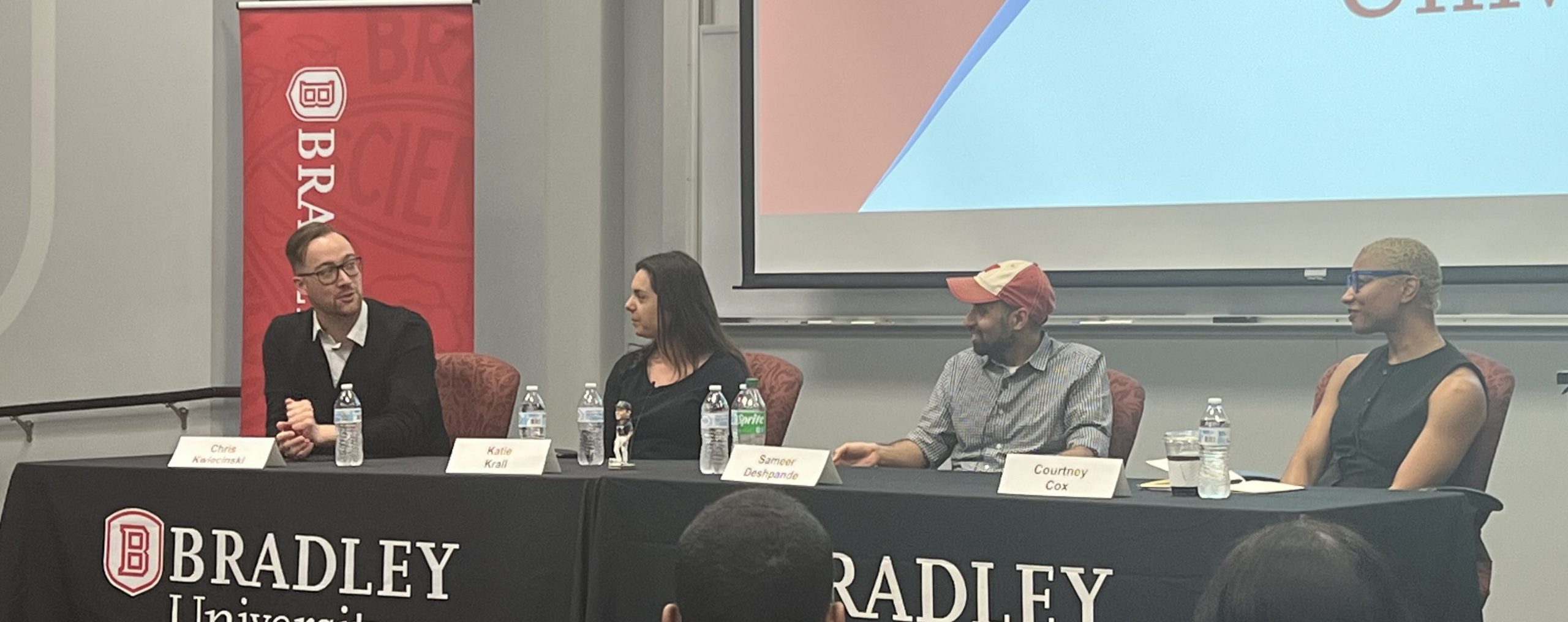
While many start with sports in mind, some find their way there through the developing field of sports analytics. Panelist and assistant professor in statistics at the University of Wisconsin-Madison, Sameer Deshande, emphasized the growth within sports for those who least expect it.
“I think I’m in a unique spot; I did my PhD training at a time when, if you were a statistician and you were interested in sports, you just did it as a side project,” Deshande explained. “What happened was people started getting hired in teams, and a lot of my friends ended up working for teams, and a lot of them ended up being very successful.”
With the robust variety of topics discussed, each audience member left the GCC with their own unique takeaways.
“[I definitely liked] more of the end, the part when they were talking about how to properly use the stats and then the kind of ethical parts behind it too: what can they give away? Where’s the line?” Tim Shepard, a sophomore public relations and graphic design major, said.
Beyond the symposium, Bradley applies its wide range of sports communication topics to its dedicated department as well.
“Our program is more all-encompassing than most other programs are. Most other programs are very specific, only sports management, business or sports journalism, but we do all of that here,” Dickhaus said.
With another year of relevant topics covered, the department looks forward to the next annual Steiner Symposium to address new concerns.