
There’s a common trope in crime dramas and true-crime documentaries: systemic setbacks that let an obvious suspect get away.
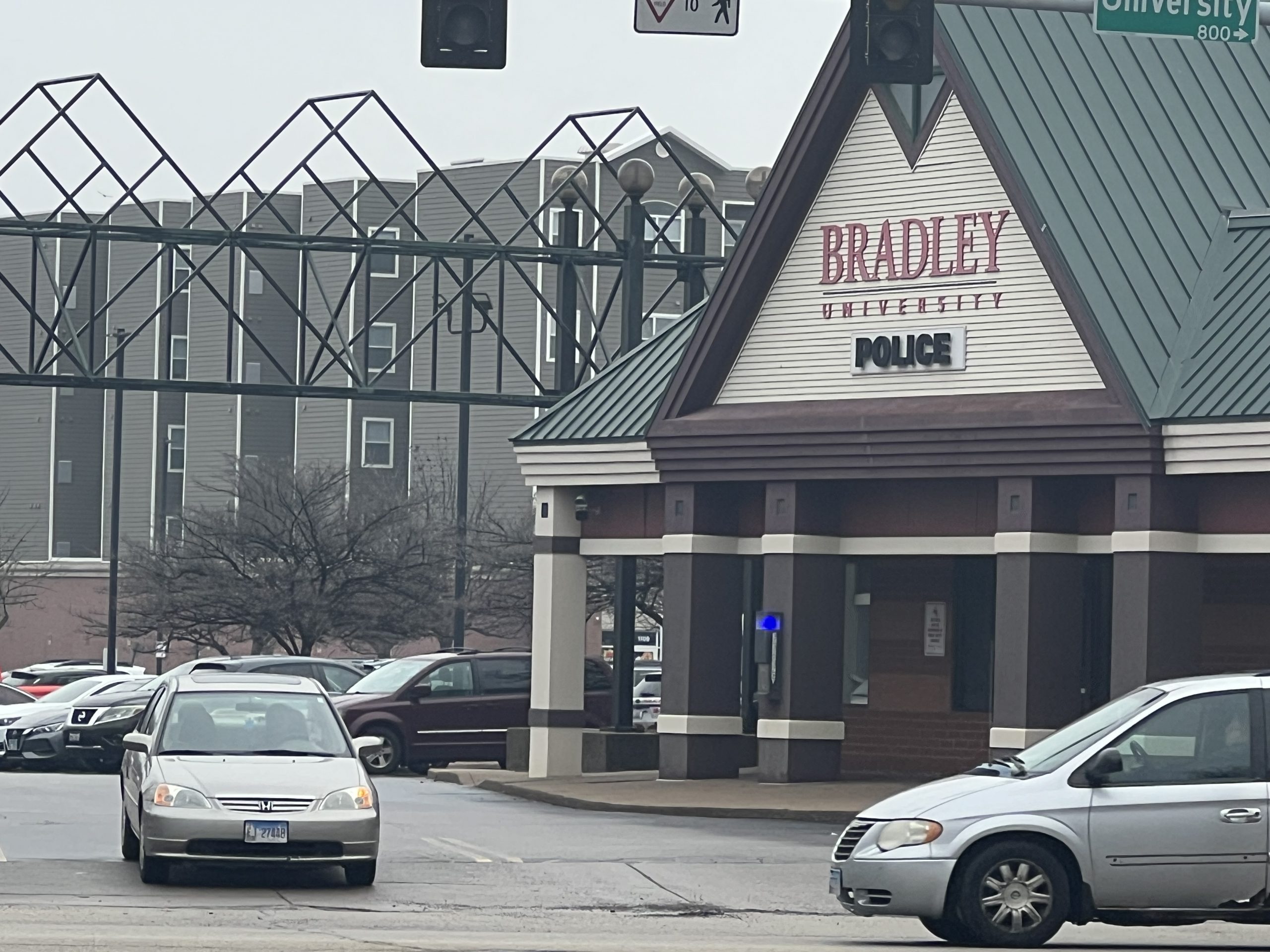
While not every bureaucratic problem can be solved, the Bradley University Police Department (BUPD) minimized one crucial issue – miscommunication – by adopting a new reporting system.
Miscommunication between police departments hinders many cases through information delays and incompatible systems. BUPD Chief of Police Brian Joschko noted another setback that isn’t as simple.
“If a person were to commit a crime, they don’t look at a map and say, ‘well, it’s in this jurisdiction or that jurisdiction,’” Joschko said. “So they may commit one crime in one police agency’s jurisdiction and commit their next crime in [another].”
“And so, if we’re not sharing that information amongst the agencies, we don’t know that maybe there’s a crime trend happening that we might otherwise not be aware of,” the chief explained.
The new reporting system, Tyler, addresses this issue by implementing software known as computer-aided dispatch (CAD). It functions by running live dispatch updates of all participating police agencies and fire departments on a single program, allowing dispatchers and officers to stay informed independently.
Tyler not only makes catching flighty suspects easier, but it also prevents uninvolved parties from getting implicated with one simple change.
“[In] the old process, you’d enter [information] in one system and then you’d have to type it from that system into another. And so, a person’s name – like Joschko, which is not exactly the easiest name to spell – you could very easily mistype that,” Joschko said. “Now, if a person is a victim of a crime, we look them up, and we’re able to just copy that information from one system into the report writing system.”
For BUPD dispatcher Michelle Otten, the key is in Tyler’s utility.
“Before, we just had to wait until we either heard [a call] come across, and we’d sometimes have to call and be like, ‘did you guys have something in our area?’ Now, we can just click on it and we [can] bring up the information, so we don’t have to do that,” Otten said. “I think it’s going to make response time even quicker.”
While the new changes address potential problems, they’re urgently needed in practice as well.
A recent car chase incident, in which six teens sped through jurisdictions, school grounds and traffic stops, came to an end because of collaboration between the county, city and Bradley police departments.
The demand for fast responses is immediate, but it’s not a new trend. Neither is the CAD project.
“It takes years to do a process like this, and it’s been in the works for years at this point,” Joschko explained. “The city of Peoria is the one leading the way … [they] received the grant to make this possible.”
As a collaborative effort, the city of Peoria reached out to more than just the BUPD.
“The sheriffs’ department, the city police department, Beville Police Department … the Peoria Heights Police Department, and there’s a couple other smaller police departments,” Joschko listed. “They’re all essentially part of it.”
With the technological changes came physical changes to the dispatch station as well. Tyler’s implementation highlighted the need for a new office arrangement.
“So dispatchers were facing [the wall]. Why that’s a problem is because the public, from the windows, could see what’s on the monitors,” Joschko said. “We very easily could have sensitive, protected information … and so we’re required to safeguard that.”
Adjusting to a new office arrangement became one task to replace the many that the new separation of facilities diverted for the dispatch staff.
“So, the facility side is going to be doing facilities work as far as taking the maintenance call, doing the operating line and dispatching calls for the maintenance people,” Otten said. “It’s going to let us focus a lot more on the specific job [rather than] trying to do multiple things at once.”
The separation of facilities becomes a necessity as Tyler’s convenient connection of police departments and compilation of camera footage, reports and live maps into one software can lead to information overabundance.
“We went for the training, and right now, we still have a lot. We have some things to learn,” Otten said. “But the good thing is that the officers are up and running on it. We can see they’re implementing theirs first, and then we’re going to be able to.”
BUPD started using Tyler only two weeks ago, but the changes have been rapid. With the shifting communication system, office reorganization and facility changes, BUPD moves toward making the Bradley community safer and making miscommunication nothing more than a cop drama trope.