
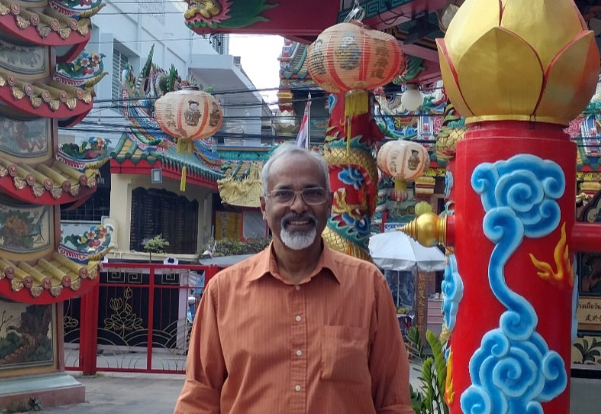
History makers often find themselves in the midst of it. For associate professor Thomas Palakeel, that scene was 1960s India.
“Early on, I was part of the first generation who grew up in free India after the British left, so I was very aware of the presence of the English language,” Palakeel recounted. “We had our language, our books, our literature, our culture. Everything seemed almost complete, but I came to an awareness that I would have to learn English. And I rolled up my sleeves and worked on it.”
What seemed like a skill born out of necessity flourished into a life-changing experience for the professor, who is set to retire this spring after 33 years of teaching in Bradley’s English department.
As he reflected on his relationship with the English language, Palakeel described reading certain works – such as T. S. Eliot’s poem “The Waste Land” – as transformative experiences.
“[Without] reading ‘The Waste Land’, the world would not have opened up to me the way it did in college,” Palakeel said. “So, in ‘The Waste Land,’ we see a modern individual struggling with tradition and the changes in technology, especially in the post-First World War period.”
“In some ways, the poem is very elusive; you need help reading each line and each allusion there,” he explained. “And yet, this modern poem turned out to be a summation of the entire Western and Eastern civilization.”
However, because of the poem’s layers, Palakeel wasn’t able to grasp it fully until his college years in India, where he pursued bachelor’s degrees in American literature and English at St. Thomas College and Loyola College, respectively.
While a master’s degree in Fine Arts in fiction took him to Eastern Washington University and the United States, it was during his PhD pursuit at the University of North Dakota that he first heard of Bradley.
Beginning his Bradley legacy in 1993, Palakeel saw the university not as a destination, but as a stepping stone.
“When I arrived at Bradley, I was encouraged to develop a new course dealing with the literatures of India, China and Japan. So that was one of my first breakthroughs in my intellectual development,” Palakeel recounted. “I branched out into Chinese literature through Buddhism, which came from India, which was also a product of literature. And then from China, it went to Japan and became instrumental in the development of the Japanese language and literature.”
“All that complete trajectory would not have been possible without English for me,” the professor noted.
While Palakeel’s classes broadened students’ horizons, some hit too close to home.
“I taught [Bible literature] only twice, because there was some resistance to it – half the class would say it was very good, they loved it, and half the class would feel challenged,” he said. “We have a new understanding of how to read the Bible. I grew up Catholic, so that kind of attitude toward the Bible was frowned upon officially until the early 20th century. Now, historical criticism, language criticism, they are very legitimate, but most students may not know about it.”
Even though the professor eventually stopped teaching this class, the mixed reviews didn’t stop him from taking more risks.
“I became interested in screenwriting while teaching literatures of Asia, which I started in ‘95, and so I had to teach one class in that area almost every semester. And then in ‘02, I started teaching the art and craft of screenwriting,” Palakeel said. “So that class developed steadily, and I devoted a lot of my time to improving it and offering it regularly.”
From religious literature to screenwriting and more, Palakeel has covered many subjects and shared his passion for language with many. For students like junior animation major Oliver Sheaff, the professor didn’t ‘fix’ students; he helped them grow.
“He [really] cares about the students and the stories they’re trying to tell,” Sheaff said. “He’s a creative writing person, but he’s very much all about, ‘this is your story. I want to make it better so that it is more understandable to a wider audience, so more people will see it. More people will read it. More people will hear your story.’”
Throughout the years, Palakeel strived to get his students where they wanted to be. Sometimes, that involved going outside the country.
“The greatest teaching moment was going on study abroad, taking students to the British Library to show them Milton’s manuscript of Paradise Lost and Shakespeare’s First Folio … the Gutenberg Bible and the oldest existing pieces of the New Testament,” the professor said.
Just as Palakeel started far away from Bradley and eventually took his students afar, his career and retirement follow the same path. After teaching himself “The Waste Land” and going on to teach generations how to put their own ideas into words, he’s now returning to exploration.
“I always wanted to devote myself to writing, and I take teaching so seriously,” Palakeel said. “I have found it difficult to complete certain larger projects because I would be responding to emails and grading papers. So I thought, since I am still fairly in good health, I could retire a little early so that I can have at least 10 more years of pure writing.”
Despite his farewell, Palakeel’s teachings will live on through students like sophomore creative writing major Jacki Bendfeldt.
“He was very, very encouraging of the work that we would be producing in class,” Bendfeldt said. “He tried to invigorate the passion that he had for the work into us, and he really motivated me to do the best work that I could. And actually, he encouraged me to submit the story that I produced in his class, and I ended up winning.”
With his departure, reluctant goodbyes are unavoidable, but Palakeel’s legacy of nurturing the Braves’ writing will ensure Bradley’s literature scene doesn’t become a wasteland any time soon.