
In 1995, social psychologists Mahzarin Banaji and Anthony Greenwald defined unconscious bias as a tendency to judge experiences based on past incidents.
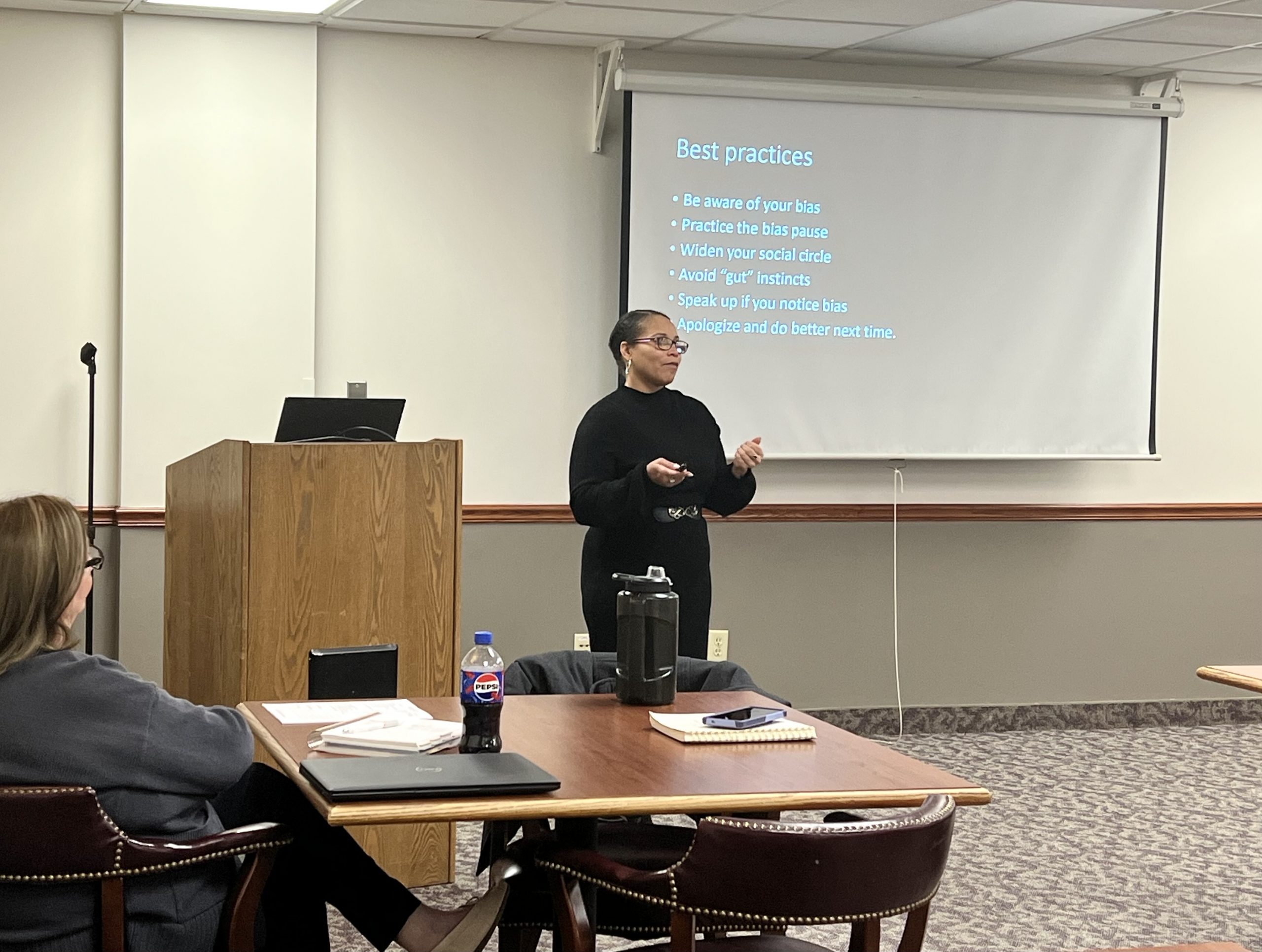
While the term itself is somewhat recent, the phenomenon has been around for as long as humans have interacted. With that in mind, the executive director of the Office of Campus Culture and Climate, Sonja Jordan, hosted an open conversation about the issue on Dec. 4, gathering attendees in the student center executive suite.
Jordan highlighted a go-to approach to raising awareness of difficult topics like everyday biases.
“I realize that we’re at a university, and there are a lot of brilliant minds around here, but sometimes you just need the ease,” Jordan said. “You just need to talk about it on an easy level; We don’t have to dissect everything.”
With that, the presentation steered away from Banaji and Greenwald and towards describing the most common biases found at campuses like Bradley.
“If someone has done something terrible, that is the only thing that you ever see, and that’s it. From that point, you have that one judgment about that person,” Jordan said. “That is part of the horn effect.”
Essentially, the horn effect is a form of cognitive bias where a single negative trait induces a negative overall impression of a person; meanwhile, the halo effect is the opposite, representing a positive bias. However, Jordan argued that neither bias is ideal..
“They [researchers] do blind studies where all the students are enrolled in the same online class with the same instructor, but half of them think that the instructor is male, and half of them think that the instructor is female,” Jordan said. “They [students] will give the male higher points for brilliance than the so-called female. So that’s a really wonderful study, because that shows us too that this kind of positive bias toward men ends up unintentionally disadvantageing women, because women are getting lower ratings.”
With unconscious bias appearing in many contexts, some, like professor of sociology and anthropology Jackie Hogan, have taken a more proactive approach.
“[A male colleague] made a sexist joke, and … we were all uncomfortable with it … I didn’t want to call him out in front of everybody, so I went away and gave it some thought,” Hogan said. “Then about a week later, I asked if I could come and chat with him and just said … I know that you probably weren’t aware of the vibe in that room or how women in that room experienced what you said. So let me share what I experienced from what you said.”
Hogan’s measured approach was encouraged by Jordan, who advocated for a more preventative habit: bias pause.
“It’s just taking that time to think and slowing down your brain, because we’re weird, you know, practicing that unconscious bias, it’s quick. [Unconscious bias is] something that we don’t even realize is happening,” Jordan said.
Reflecting on the common perceptions of unconscious bias, Jordan magnified a blind spot.
“I just really think that it’s the self-awareness of knowing that, as human beings, we all have biases,” Jordan said. “Unless people are doing the work, they’re not thinking about that.”
For those who are curious about their own unconscious biases, Jordan offered a solution.
“Widen your social circle, because if you are not aware of your biases, surrounding yourself with people from a different background is going to bring that to the forefront, and it is forcing you to address your biases and to be self-aware,” Jordan added.
Looking ahead, the Office of Campus Culture and Climate will provide opportunities for widening social circles as well as providing awareness of common biases in romantic contexts in media with their upcoming “Palentine’s” event – a Valentine’s spin-off – in Feb. 2026.