
This article contains spoilers for “Lanterns” season one (2026)
“Lanterns” is the kind of show that gets better the more you think about it.
At first, it looks like a murder mystery disguised as a superhero show, but by the end, the fact that it’s a superhero show almost feels secondary.
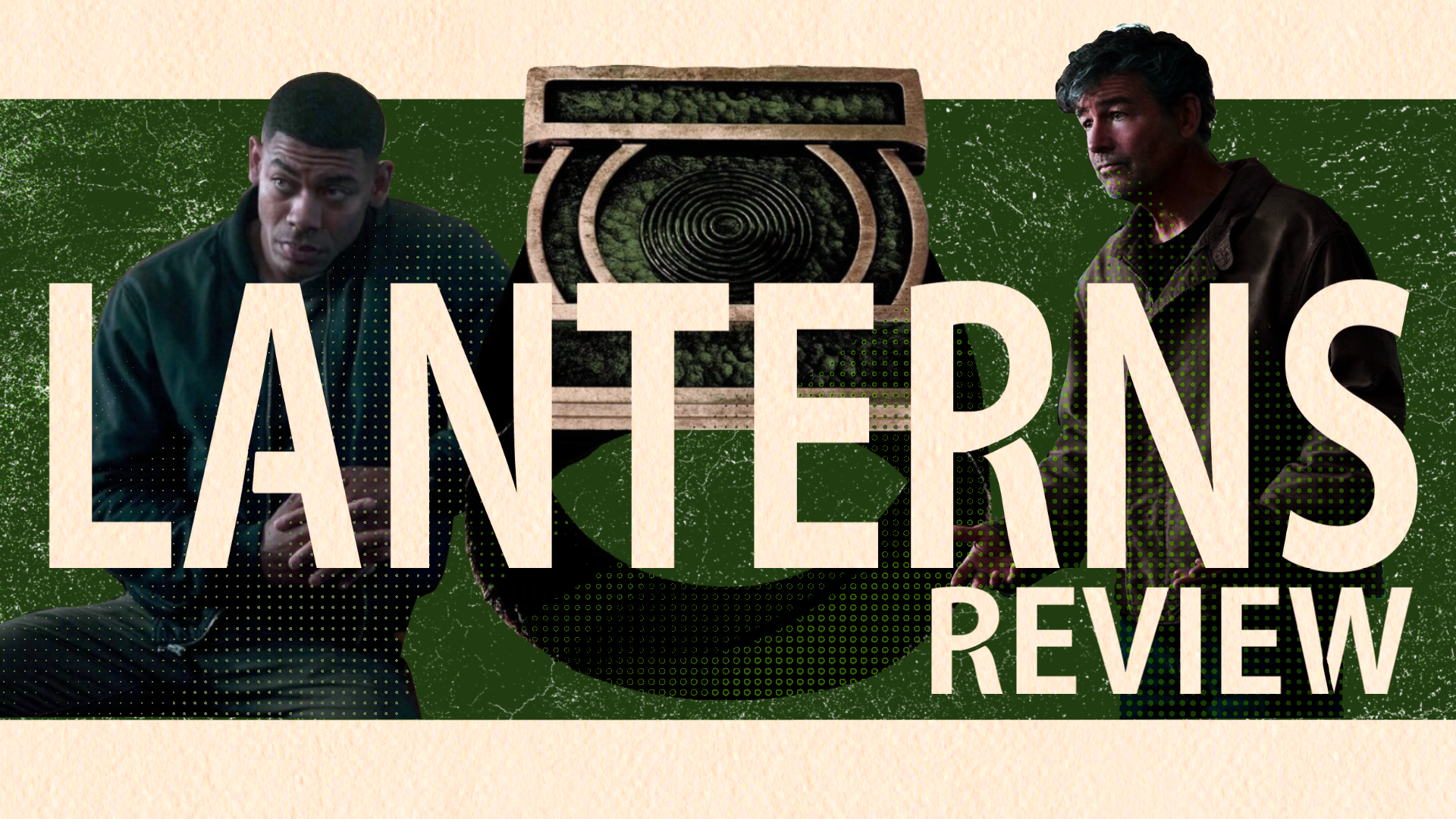
In essence, the series is a character study of John Stewart (Aaron Pierre) and Hal Jordan (Kyle Chandler), and their relationship is what makes “Lanterns” so engaging.
The way the show uses both characters to explore fear, courage and what it actually means to be worthy of the Green Lantern ring is what drew most fans back to the series every Sunday night.
“Lanterns” feels grounded. It doesn’t constantly remind viewers they’re watching a superhero show. Instead, it gives you characters that you take seriously, gives their background and history real meaning, and lets their relationships carry the story.
The undeniable feeling about this show is that “Lanterns” isn’t trying to show who these characters are, with or without their fancy green constructs. It aims to explain why they became this way.
And that’s what makes this show such an exciting start for the new DCU reboot.
A two-part premiere
Episode one, “Pilot,” does everything an inaugural chapter should. We’re immediately introduced to the candor of Hal and John’s relationship. The interactions are tense, and the subtext work from the actors is stellar.
This episode also sets in motion all the mysteries the show will unpack later. The pair travels to the small town of Rushville, Nebraska, where Hal had received his ring so many years earlier. Now, in this context, that means 2016, they meet Kerry Kane (Kelly Macdonald), the local sheriff.
At a bar, John meets Zoe (Poorna Jagannathan). They sleep together before she reveals she’s married to Will Macon (Garret Dillahunt), the town’s preeminent businessman, essentially running Rushville from his ranch.
Hal believes one of the spectators at a high school football game is an alien in disguise. Police bring the suspect to the station for interrogation.
Here’s where everything opens up.
Hal interrogates the suspected alien. In one brilliant scene, our assumptions about Hal’s inadequacy vanish.
He’s extremely capable, eventually getting the person across the table to admit he’s not human at all.
The alien reveals something is wrong in the town, before causing an explosion that Hal contains. Now, all the pieces are in place.
Except one.
We flash forward to 2026, where, on the exact same football field, Sheriff Kane shows John the dead body of Hal Jordan.
Two mysteries, 10 years apart. If pilot episodes are supposed to build intrigue, this one does it in spades.
Episode two, “Trust Fall,” is more of the same. The Lanterns split up, with John heading to get Hal’s lantern to recharge the ring while his partner continues to investigate in Rushville. On the way, more aliens from the football field capture John.
In a somewhat clunky exposition dump, the aliens tell John that Rushville is home to a Manhunter in disguise, who poses an existential threat to the planet. They give John an ultimatum: Find out who the Manhunter is in 48 hours, or they’ll blow up the town. John gets a phone to contact them and is told to head back to Rushville.
Now the mystery has not only an identifiable target, but also urgency.
The first pair of episodes do their job. They establish what’s at stake, build excitement for the rest of the season and begin to develop the relationship between John and Hal.
Unfortunately, the next episode pauses the main story. Fortunately, it’s one of the best in the series.
A welcome interruption
Episode three, “OutKast,” is brilliant in every way.
Taking a break from the Manhunter investigation, the episode steps back from the buddy-cop dynamic and gives viewers a full understanding of why and how John Stewart operates the way he does, in three words.
“Are you afraid?”
That’s the biggest question that Stewart and his family revolve around. John’s father failed to overcome his fear and, when questioned, was denied access to the ring. His parents make sure John doesn’t repeat that mistake, so they shape his character and build him into a fearless soldier.
John’s parents followed the mindset that becoming fearless isn’t a choice, but rather his duty.
That makes the John we’ve seen in the first two episodes feel completely different. His stoicism, discipline and confidence aren’t necessarily innate traits. John gained them because his parents crafted them into him; he was raised to be something he never asked to be.
Episode three does a great job of exploring the relationship between fear and race. John’s father’s fear isn’t weakness. As a Black man living in a society built around racial inequality, his fear is undeniably understandable.
The Guardians miss the biggest flaw in their system when they choose a Green Lantern for the corresponding sector. Their definition of fearlessness doesn’t account for the realism and struggle at the table.
Then there’s Hal.
The knowledge that John’s father failed to appeal to the Guardians’ definition of fear makes the relationship with Jordan and Stewart a lot more interesting. Hal is everything John was trained to become.
Fearless, confident and capable.
But the reason Hal is capable and fearless is very different from what it’d take for Stewart to be the same. That’s exactly why Hal has a lot more to learn about fear than he realizes.
Episode three, “OutKast,” feels like a break from the main mystery, but it’s one of the most important episodes in the series. It establishes the conflict between fear and courage, which ultimately defines who the person in the ring is.
An early pinnacle
Episodes four and five feel, in many ways, like the season’s climax. Fitting, because they’re not only the story’s peak, but also the season’s quality peak.
Episode four, “The Weenie,” is pitch-perfect television. It has action, twists, ring constructs – basically everything you could want from a Green Lantern show.
Most importantly, this section of the show finally builds the chemistry between John and Hal. Their grudging respect starts to turn into genuine trust.
Until it’s all ripped away.
At the pair’s motel, Zoe shows up at John’s door. They share another night, before Zoe leaves. As she does, her truck is abruptly hit with an orbital laser, seemingly killing her. Only by this point, John has figured out the truth.
Zoe is the Manhunter.
Later, as Hal and John drive back to Rushville, Hal reveals he knows John has realized who Zoe really is, then leaps out of the car, which crashes into a pole.
The episode centers on the relationship between Hal and John, which throughout the season, is the best part of the show. We see it open up before the door abruptly closes once more. Hal has a job to do, John is now a liability.
Chandler and Pierre are at their best in this episode, selling every line with a slowly budding chemistry before the tension peeks back in.
Episode five, “Lights Out,” picks up right where the last episode left off. We split between Hal and John again, as each deals with the fallout of the Zoe discovery. Orbital strikes from the motel begin raining down on Rushville as Hal tries to balance protecting the people with stopping Zoe.
It’s comfortably the most action-packed episode of the series.
Hal once again displays his competence, drawing Zoe out until John returns and subdues him. In his last moments of consciousness, he uses his ring to save both himself and John from another orbital strike. John then takes the ring, kills Zoe, and leaves.
The episode’s final moment is the best of the show. From birth, John has been groomed by his parents, the government and the Guardians to become the Green Lantern.
To accept his “destiny.” To follow orders without hesitation. Now, he has the ring. The Guardians approve. There’s nothing in his way anymore.
And for the first time in his life, he says no.
John leaves the ring on the table and leaves, finally choosing what he wants to be.
In the best writing flourish of the series, “Lanterns” chooses compelling characterization over the easy way out.
With that, the 2016 timeline is wrapped up. One mystery closes, and another begins.
A satisfying solution
Episode six, “Bad Optics,” is where “Lanterns” starts to display John’s relationship with the Corps, reeling back into his decision in the previous episode.
After spending his entire life being pushed into becoming a Green Lantern, John has every right to want nothing to do with it, or the Guardians. He has seen what the ring did to his family and in “Bad Optics,” John attempts to balance the wants and needs of his life at hand.
Ten years later, in 2026, John has reached a new life. Closer to his family, he’s moving up in his love for architecture, until he gets a call from his mother, which leads him to talk with Hal. Stepping foot into Rushville again ultimately leads him to be reminded of the decision he made years ago.
John isn’t simply rejecting the job as Green Lantern because he doesn’t want the job – he rejects it because he doesn’t believe in what it represents anymore. The Guardians spend a great deal of time deciding who is worthy, while failing to understand the people they’re supposed to protect.
The next day, Hal turns up dead. John tries to call in current Green Lantern, Guy Gardner (Nathan Fillion) to help solve the murder.
John’s dynamic with Guy Gardner reinforces this; Guy represents the kind of Lantern John has had enough of, arrogant and comfortable with the power bestowed on him.
Meanwhile, John understands exactly what that power costs.
And with that, John decides to take on the role of finding out what really happened with the death of Hal Jordan – snatching the ring for his own, and investigating the “Bad Optics.”
“The Jordan Boys’ Legacy” is a perfect segue from the last episode, making episode seven the most important, as viewers finally understand Hal Jordan.
For most of the season, Hal is presented as this larger-than-life Green Lantern who always seems to have the answer, often using his “gut” as the guidance to every situation. Episode seven finally shows the person beneath all that confidence.
One reason “Lanterns” is so good is the dynamic between Kyle Chandler and Aaron Pierre. Both performances are amazing, with Chandler and Pierre bouncing off of each others’ emotions and energy.
John Stewart was raised to eliminate fear, while Hal Jordan learned to hide it. They look different on the surface, but both are products of fathers who taught them to be ashamed of fear.
Chandler is pulling double duty here, playing the hologram version of himself in 2026 that’s actually a recording of the version of him from 2006. He walks a fine line between keeping the character consistent with the one we know best, while also differentiating enough to make it clear how much he changed in ten years.
The hologram – or as the internet has taken to calling it, the Halogram – is especially effective because it lets John finally see Hal without the arrogance. For the first time, John isn’t looking at the Green Lantern who always challenged him.
He’s staring at the person underneath the ring. Being fearless is a big theme in “Lanterns,” but Hal wasn’t. He was just really good at pretending.
Episode eight, “Dirt and Stars,” is where everything pays off. After spending the entire season running from being a Green Lantern, John finally chooses the ring. But the important part isn’t that he becomes a Green Lantern. It’s why.
Aaron Pierre has a phenomenal performance in the last few episodes, appealing to both sides of John Stewart. Ten years ago, he was afraid of accepting the responsibility. Ten years later, he comes to terms with his emotions and embraces them completely.
The execution doesn’t quite live up to the idea. There’s a fair bit of information dumping that pulls the overall quality down, but the eventual conclusion is a powerful one.
The final resolution to John’s story works abundantly. “OutKast” taught us that John was raised to believe fear was a weakness. “Dirt and Stars” showed us that he has come to terms with fear.
“Dirt and Stars” is a bittersweet ending to “Lanterns.” Following John’s story as he attempts to balance two sides of his life, while tackling his emotions head-on, was a journey that honestly never got dull.
The overall story
At its core, “Lanterns” is a story about generational trauma and expectations. Hal Jordan is only fearless because he has nothing to lose. Jon Stewart is only fearless because he gave up his childhood. They take different paths, but they’re one and the same.
Kyle Chandler and Aaron Pierre are the show’s clear highlights. Each gets their time to shine on their own, and the chemistry they have on-screen gives us the best moments in every episode.
Whether or not we ever see Chandler as Hal Jordan again, he’s already one of the best comic book casting decisions ever. He’s relentlessly charismatic, selling the brokenness of a character who wears a jaded facade to hide his pain.
Pierre is equally magnetic. He starts the season reserved and slowly opens up as it goes on. By the end of the show, the man who was once impossible to read is openly embracing his emotions, and Pierre sells it the whole way.
The setting, cinematography and direction are all supremely consistent throughout. Long, cinematic shots paired with open expanses of rural Nebraska give the entire show a sense of grandeur that betrays how localized the true plot is.
It’s not a perfect season, though, mostly due to poor pacing.
The first five episodes feel like a completely different season from the last three. If the show were 10 or 12 episodes, this problem could’ve likely been alleviated. Instead, the show feels rushed in the first half and slow in the second.
The finale isn’t a whimper, but it’s not exactly a bang either, leaving the full story a little unfinished and unsatisfying. The season feels off-balance, and the dueling mysteries don’t get the attention they deserve.
For all its faults, though, it does the one thing it really needed to do: get audiences excited about more Green Lantern in the DCU.
After the terrible 2011 movie, the Green Lantern brand needed a refresh. This show did that.
Aaron Pierre’s John Stewart is poised to be a DCU staple for years to come, and if this show is any indication, he’ll be a household name before long.
Rumors of a “Lanterns” season two are already percolating, and if it’s as good as season one, we’ll be tuned in every Sunday night.