
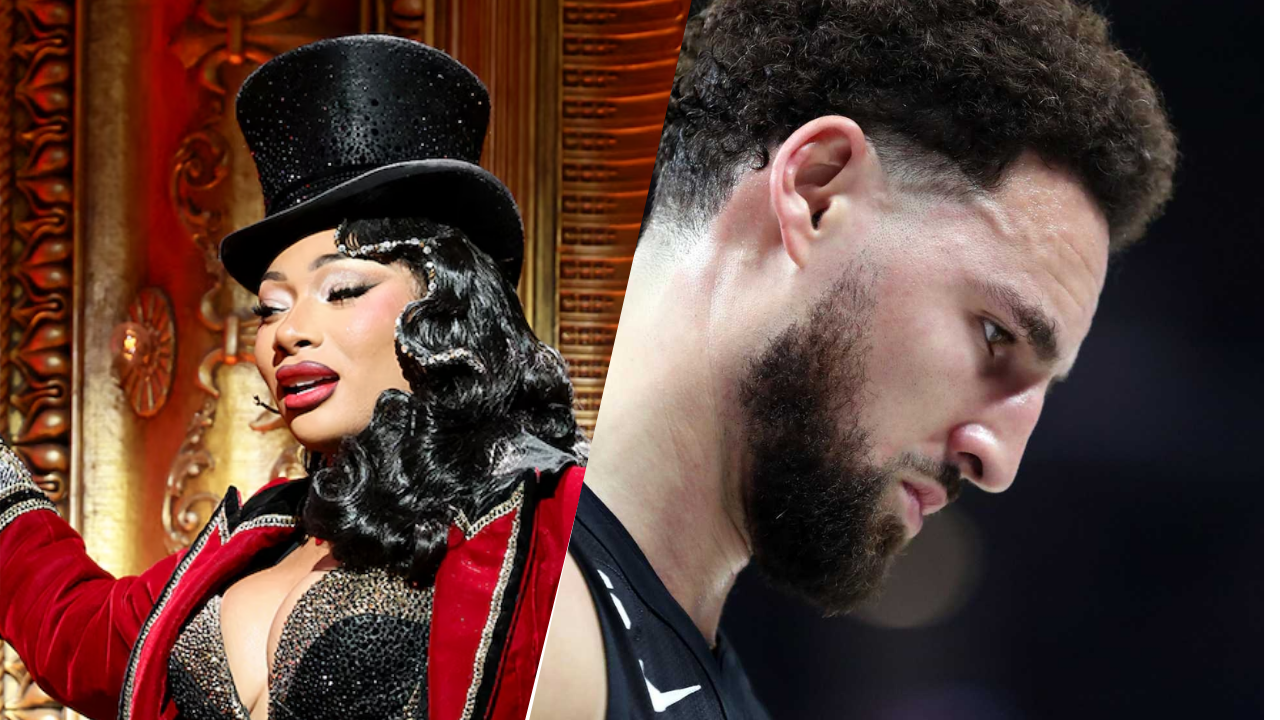
Houston rapper Megan Thee Stallion, whose real name is Megan Pete, announced a split from her partner, Dallas Mavericks wing Klay Thompson, after he allegedly told her he was unsure about their relationship status.
The Grammy Award-winning artist took to Instagram to express her story, saying, “Cheating, had me around your whole family, playing house, holding you down through all your horrible mood swings and treatment towards me during your basketball season, now you don’t know if you can be monogamous?”
The post took the internet by storm, and as expected, people were very normal about the whole situation.
Notable pillars of the community and upstanding gentlemen, such as DJ Akademiks and Lil Duval, praised Thompson for being a “playa” and a “real N-word” for his alleged actions, while others pointed out that Pete’s past was too muddied for Thompson, for any “man of high status,” to take her seriously.
Meanwhile, others took Pete’s breakup as an opportunity to point out that they never thought Thompson was attractive in the first place, stating that you shouldn’t give “medium ugly men” a chance, expressing how they found it unfathomable that he could cheat on someone as attractive as Pete, even going as far as saying they’d be cheating all summer to get their revenge.
Additionally, people speculated that Thompson had cheated with WNBA player Lexie Brown, claimed that nobody knew who he was before dating Pete and even manifested that he would get injured and play badly next season.
The reactions to a situation that is, frankly, none of our business and not worth our time, reveal some of the most significant issues our society and culture faces. These issues have only been exacerbated by the growth of the internet and social media and have little to do with Pete and Thompson specifically.
First, a notable portion of men online didn’t just dismiss the situation – they celebrated it. The idea that juggling multiple women or refusing monogamy (at the expense of women) is something to admire has been a pillar of the patriarchy for thousands of years and has become increasingly normalized in certain corners of the internet.
It’s framed as status, as leverage, as proof of desirability – usually by men who are subconsciously insecure and in desperate need of validation. It reflects a shallow understanding of relationships, where loyalty is seen as a liability rather than a baseline expectation.
There’s nothing wrong with polygamy when all parties are on board; being the real “playa” is having your way while being completely honest.
That mindset doesn’t exist in a vacuum. It closely mirrors the rhetoric pushed by red pill and incel-adjacent spaces, where emotional detachment and domination are encouraged while empathy and accountability are mocked.
When figures like DJ Akademiks and Lil Duval praise this behavior, it reinforces the idea that hurting someone is not only acceptable but commendable. Unfortunately, we live in a society where a woman’s perceived value is closely tied to the number of men she sleeps with, with the inverse applying to men; the more partners, the better.
But celebrating cheating – regardless of who’s doing it – is fundamentally loser behavior. It trivializes something that has very real psychological consequences. Cheating isn’t just a “mistake” or a “slip-up” – it can dismantle someone’s sense of trust, damage their self-worth and leave lasting emotional scars.
If we’re being honest, it shares many characteristics with emotional and mental abuse, yet we rarely treat it with that level of seriousness.
On the other side, the response from many women wasn’t much better.
Reducing Klay Thompson to his appearance – calling him “medium ugly” or implying he was never attractive enough to begin with – completely misses the point. It insinuates that cheating would be more understandable, less likely or less costly if he were more conventionally attractive, which is a flawed and counterproductive thought process.
Attraction has nothing to do with integrity. Cheating reflects character, not looks, gender or status.
You can get done dirty by Jay-Z or Michael B. Jordan.
Framing cheating as more egregious because the person being cheated on is especially attractive also veers into objectification. It reduces people to their physical appeal, as if their value – and the severity of the betrayal – is tied to how they look.
By that logic, someone less conventionally attractive would be less deserving of loyalty, which is clearly absurd.
And while some reactions are framed as solidarity with Pete, there’s a fine line between feminism and misandry. Blanket statements about men being inherently unfaithful or deserving of retaliation don’t advance any meaningful conversation. At that point, it stops being about accountability and starts resembling the same kind of broad, toxic generalizations often criticized in male-dominated spaces.
It’s also entirely parasocial. Get a grip.
Ultimately, this situation isn’t about picking sides. It’s about recognizing how quickly discourse devolves into toxicity, where bad behavior is either glorified or weaponized depending on who’s involved. If there’s a takeaway, it’s that cheating should be universally condemned – not filtered through gender wars, internet clout or superficial beauty standards.