
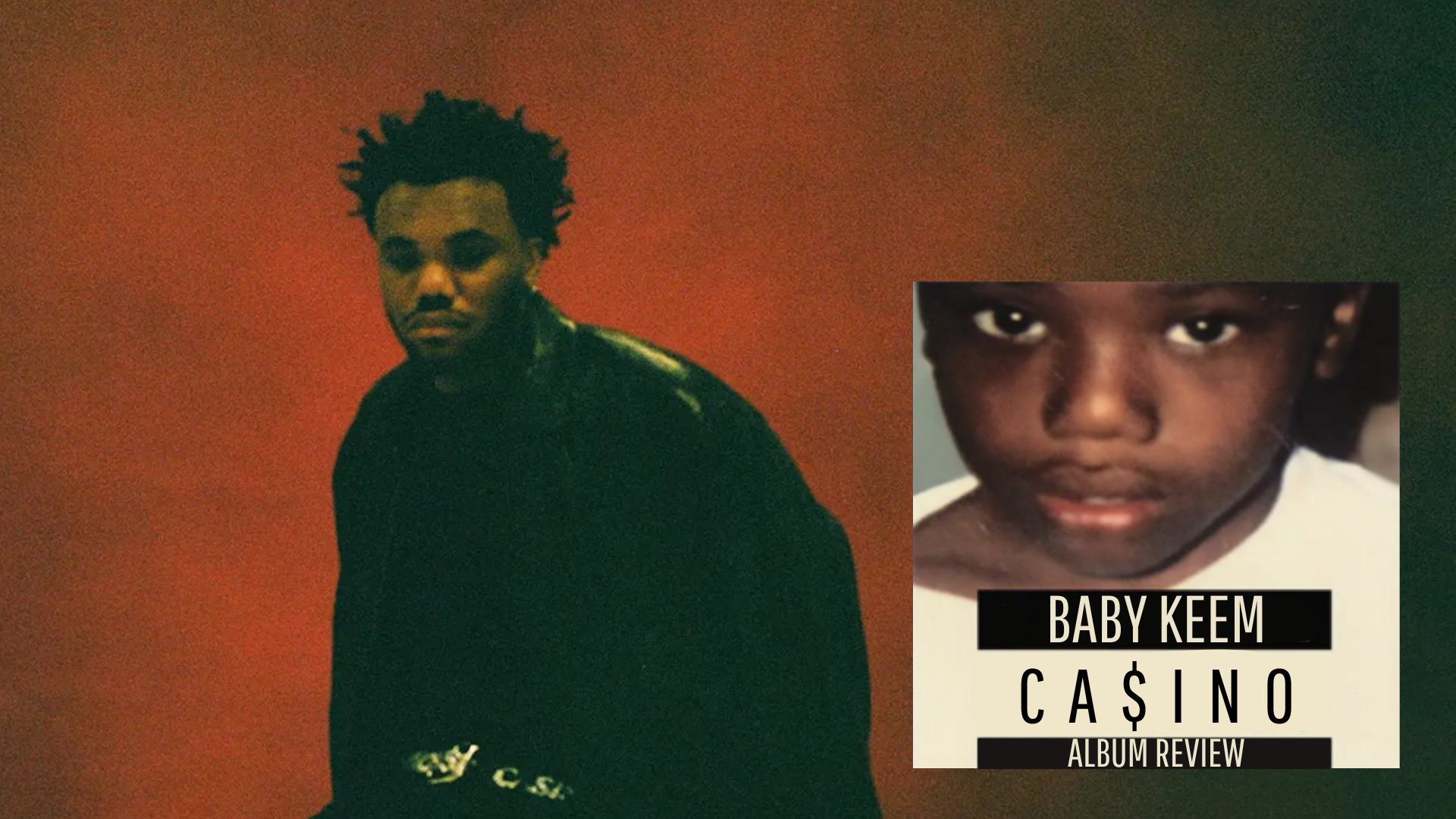
As a rapper from Las Vegas, “Ca$ino” is an apt name for Baby Keem’s newest project.
Five years after his star-making debut album “The Melodic Blue” was released in 2021, Hykeem Jamaal Carter Jr., a.k.a. Baby Keem, returned with an 11-track, 37-minute record. For that long of a hiatus, your project has to be nearly undeniable to feel worth it.
“Ca$ino” isn’t.
There’s plenty of great moments interspersed across the album, but in many ways, hitting play feels like spinning a roulette wheel.
Take the opener, “No Security.” It’s a calm introduction to the album, set to a soft, drumless sample of Natalie Bergman’s “You Can Have Me,” accentuated by floating piano chords. Keem speaks about his struggle to write more music, rapping, “Throwin’ crumbled paper at the wall, drawin’ blanks / I’m a genius, I was told, I’m a genius, I was chose.”
But for those of us hoping for the high-energy we’ve come to expect from Keem, you don’t have to wait long.
If the album is a “Ca$ino,” then the next song is the feeling of hitting your first bet.
The second and title track is absolutely nuts. The first minute-and-a-half are driven by crunchy, synth-based production that would fit right in on a Playboi Carti album. But unlike a Carti album, the rapping is extremely high-level.
Keem’s command of pace is at a career-high on this track, effortlessly flowing over a beat that could kill a Republican congressman. It’s the infectious, energetic delivery that made him a superstar in the first place.
That’s the first half of the song.
The back half sees a more traditional beat anchored by 808s and hi-hats that powers through the song’s remaining runtime. Keem raps with a cracking voice about his mindset, returning from hiatus with no holds barred, exemplified by lyrics like, “I watched my grandma die in the house I bought, I’m livin’ my truth / I hit rock-bottom when I was gone and now I got nothin’ to lose.”
While providing needed intensity to the front half of the record, the track slightly overstays its welcome. The first verse after the beat switch is missing some of the momentum the opening half had in spades. Still, it’s an exciting start to an album where excitement is expected.
Track three, “Birds & the Bees,” tones down the exertion. Keem gets more melodic, singing over plucky instrumentation. At just two minutes long, it’s a short and sweet showcase of his knack for pop-rap with a catchy refrain and infectious flow.
“Good Flirts” is probably as close to a straight-up R&B song as Keem has ever gotten. A melodramatic ballad over punchy piano chords, he sings about missing the person he loves, trading refrains with Momo Boyd to create one of the most memorable choruses on the record.
The second verse contains a frankly bizarre Kendrick Lamar feature. He feels extremely out of place on the track, and while he does a good enough job, it changes the entire complexion of the song. Kendrick is a unique artist, but it doesn’t feel like he adds anything here that another performer couldn’t.
Kendrick makes another appearance on the subsequent song, “House Money.” This time, he’s tasked with providing the refrain. In a vacuum, it works very well and offers an excellent pacing shift after Keem’s first verse. But after a slower flow on verse two, Kendrick’s chorus kills the momentum of the song, staining what could’ve been one of the best bangers on the album. Neither of Kendrick’s features feel special, especially given how excellent his contributions to “The Melodic Blue” were.
“I am not a Lyricist” is, ironically, the most densely written song on the album. Keem touches on his family and people who should’ve been his role models that let him down. It’s his most vulnerable song to date and a display of the kind of songwriter he is capable of being, especially lines like “I wish we never came to Vegas from Long Beach / On the Strip with them demons and they all plotted on me / Everything ’bout that dirty desert took you away / County jails in the mornin’, promise you that I wait.”
We then sharply detour into “$ex Appeal,” a bouncy, west-coast banger with some excellent autotune vocals from Keem and one of the most danceable beats on the album. Until Too $hort starts rapping.
His feature here is ridiculously misplaced. It feels outdated and unserious, completely eroding much of the appeal of the first half of the song.
Do you see the pattern now?
The ideas behind most of these songs are sound, and the execution often works for at least part of the song. But when the runtime expires, you’re left with a bad taste in your mouth. A lot of these are the result of bad feature curation, which seems uncharacteristic given how well-placed every guest appearance on his previous album was.
Thankfully, “Highway 95 pt.2” is another high point, and the execution never falls off throughout the song. Keem touches more on his childhood, specifically when he was 13, witnessing the trials of his family. He floats over a minimalistic, drum-driven instrumental, singing “Outside, got a zip of weed on me / I don’t do drugs, but I hold it for the homies / I sit outside with nothin’, feelin’ lonely / No stamps at the end of the month, so I’m hungry.”
Track nine brings us back into banger territory with “Circus Circus Free$tyle.” Keem bounces between inflections every few lines, starting with a laid-back flow before launching into a grimy timbre over a beat featuring massive-sounding horn patterns and booming bass.
The beat then shifts into a far more sinister instrumental that sounds like the theme song for a Bowser’s Castle Mario Kart track. Keem’s constantly-evolving flows are exciting until he gets to the final thirty seconds, when he proclaims himself a caveman, with sound effects and all.
There’s no explaining this; you’ll just have to listen to it for yourself.
“Dramatic Girl” digs back into Keem’s pop-rap bag, with an upbeat, airy instrumental while he shows off his singing chops once again. This song also has a feature, but thankfully, it breaks the trend of poor placement, and may be the best. Che Ecru’s contribution fits perfectly within the context of the song, delivering a short reprieve from Keem’s vocals while maintaining the pace of the rest of the track.
Finally, “No Blame” is another heartwrenching song about Keem’s mother passing away when he was seven years old. He comes to terms with his mother’s faults and the impact they had on him, but acknowledges the trauma she had to deal with before he was born. In one of the most devastating sequences of lines on the record, he raps, “How could I blame you mama? / I ran from you that day, I’m not numb to those encounters / I’ve seen you in the worst way when the police say they’ve found you / Grandma told me you died, how am I gon’ live without you?”
“No Blame” is a fantastic closer to a roller coaster of an album that displays a lot of growth in Keem’s pen game, and the final track is the best example of this.
Overall, “Ca$ino” is certainly a good album. It’s tough to call it great. There are so few songs on here that don’t suffer flaws in the back half that it’s difficult to come away with a satisfying listening experience. “Dramatic Girl,” “Highway 95 pt.2” and the title track are all genuine gems, and there’s no true bad song, but nothing here reaches the heights of the best moments on “The Melodic Blue.”
In another context, this would be a solid inclusion in an emerging rapper’s growing catalogue.
But after a five-year wait, Keem wasn’t playing with house money on “Ca$ino.” This needed to be an excellent record to cash in on his remaining goodwill, and it fell short.
There’s plenty of reason to be excited about future projects from the Vegas native, but if we have to gamble on another five-year wait for 40 minutes of music that’s just “good,” it won’t be much longer before audiences come to collect.