
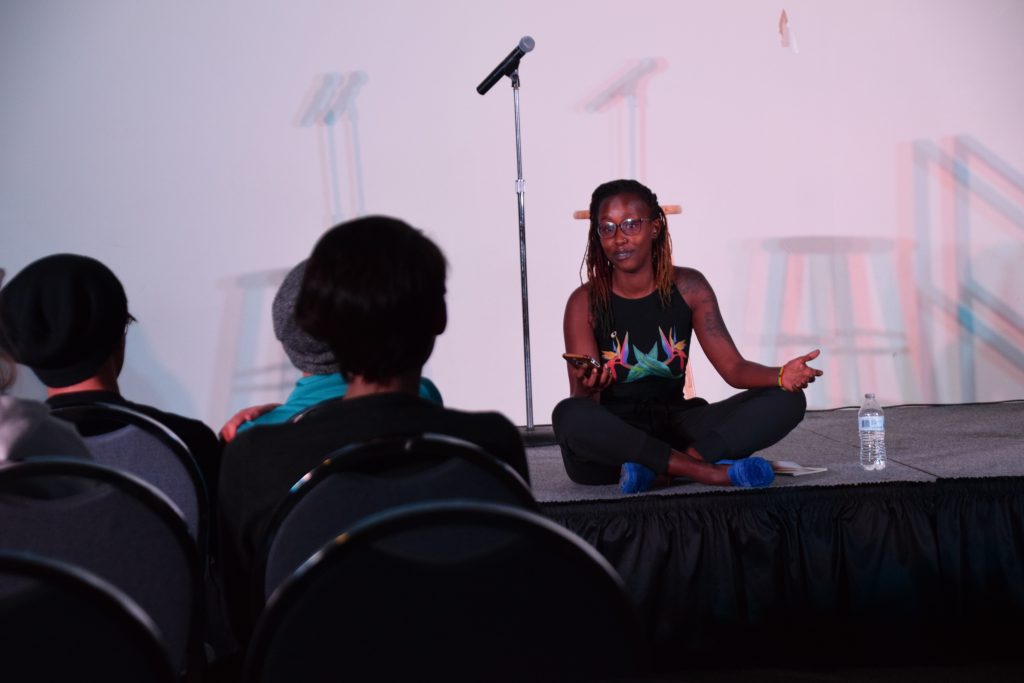
Mwende “FreeQuency” Katwiwa took the stage for a night full of hard-hitting truth and education in the form of poetry. Issues spanning from gender identity to the problems within the justice system when handling crimes against the black community, were not left untouched.
FreeQuency is a queer Kenyan immigrant storyteller. They’ve placed in poetry contests and is known for their activism in reproductive rights, Black Lives Matter and other social causes.
For FreeQuency, they explained their experience of finding themselves struggling with identity in LGBTQ community, facing racist comments growing up and living as an African immigrant in America.They put their experiences into a novel to further share.
“I’m touring my book ‘Becoming Black’,” Kitawa said. “A lot of the narratives are around Blackness as a political identity, the movement for Black lives, which is known as Black Lives Matter, and all of the different ways that it’s still relevant today.”
The event was planned by ACBU’s Critical Issues coordinator and senior English major Johnalie Almaria. She said she invited FreeQuency because of their impactful stories and voice could be helpful for Bradley students.
“[This is important], not only as a Critical Issues coordinator but also as a peer educator for Office of Diversity and Inclusion, to have visible symbols of people who represent diversity on campus,” Almaria said. “It mirrors the space in the real world and the different people you’ll meet in the work field after you leave college.”
Students were agreeing with the words of the poem, and they snapped in response. For some students, getting a chance to learn more behind the work of a poet in a space beyond ink and paper resonated more with them.
“[The] poetry was very cool and it was very powerful,” freshman game design major Avery Mackie said. “I loved the stories and the context of the poems. It was interesting to hear the experiences [they] went through versus what I’ve experienced my whole life. It was very eye opening.”
For Mackie, a quote that stuck with her from FreeQuency read: “‘Free at last, free at last…’ This is not the freedom of which we asked.” The quote was the major theme for the night, filled with a view of different realities and struggles for marginalized groups.
They made it a point to mention the dates of Black lives murdered in their poetry, and followed each with a context explanation.
“I try to make an intentional effort to not just come up here and read poems,” Kitawa said. “I believe poetry should be insurgent and doing work. I use the poetry as an avenue to really be able to tell those other in-between stories about ‘Hey, let’s talk about the murder of Treyvon Martin and the impacts of that.’”
There was an emphasis that activism is needed and equality hasn’t been reached just yet for both the Black and LGBTQ communities. FreeQuency emphasized that these conversations are important to have on campus.
For more information on FreeQuency and their works, visit freequencyspeaks.com