
A deck of cards may hold the self-revelation you need.
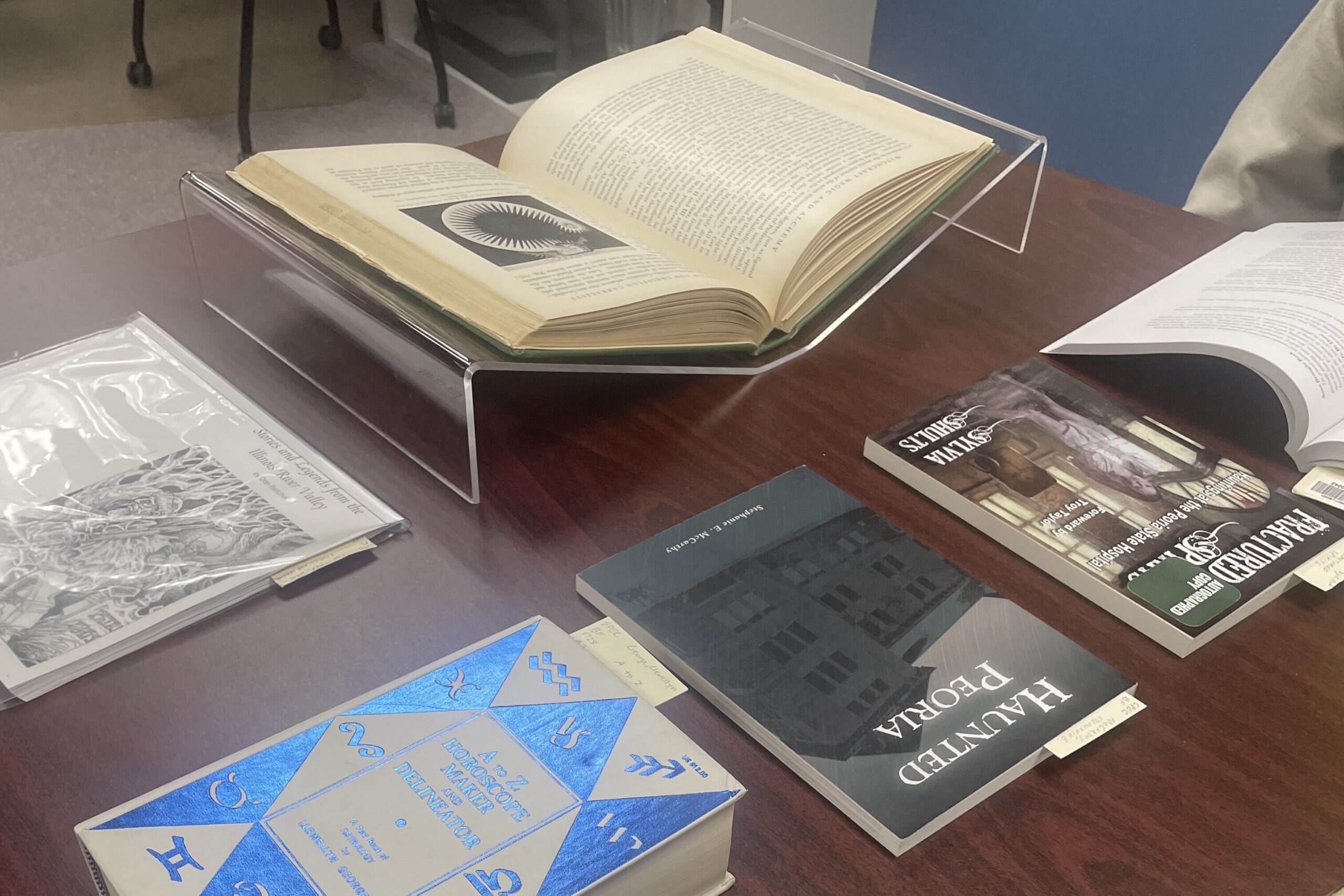
Bradley’s Special Collection Center, home to a unique collection of tarot decks, invited students, alumni and staff to explore the history, art and symbolism of tarot at their open house on Wednesday.
The tarot decks, each containing 78 cards, were displayed on a table in the middle of the room. Smaller tables in the back of the room displayed printed sheets of the “Celtic Cross,” a guide for tarot deck spreading.
Christina Norton, an associate professor and librarian at the Cullom-Davis Library, shared her tarot knowledge at the event.
Norton says tarot has existed for centuries, though it wasn’t as popular as it is now. Its origins began around the 15th century in Italy, and it started off like any standard card game, such as spades.
With the influence of occultism, a practice concerned with the supernatural and the unknown, tarot reading evolved into a representation of your journey through divination and revelation.
Arthur Waite popularized tarot in 1909 and created the influential “Rider-Waite-Smith” tarot deck; today, its symbolism often merges with pop culture, leading to “Hello Kitty” and “Star Trek” tarot decks.
“It can seem silly, but we’re storytelling creatures, and storytelling is important for us to reveal things about ourselves and to share our stories with others,” Norton said.
A typical tarot deck has 22 cards in the major arcana, while the rest belong to the minor arcana. The major arcana includes the zero card, called the Fool, which represents new beginnings and the more serious journeys you face in life. Meanwhile, the minor arcana is split into four different suits: swords, cups, wands and pentacles. These represent day-to-day encounters in life.
If you feel apprehensive about tarot, that’s understandable.
Its history is contentious, and it can seem daunting to learn at first, but Norton assures curious readers it’s not always what it seems.
“Sure, it can be a very powerful tool, but it can’t do anything without you or to you,” Norton said. “It’s connecting across time, and the tarot is meant to ask you things about yourself – like, are you really afraid of losing something? And if not, what thing might you actually be afraid of?”
Norton’s assertion suggests tarot is meant for everyone to discover revelations in their life, but it’s up to the individual to decide whether they want to indulge.
If you’d like to reserve a spot in the collection or learn more about tarot, email specialcollections@bradley.edu.