
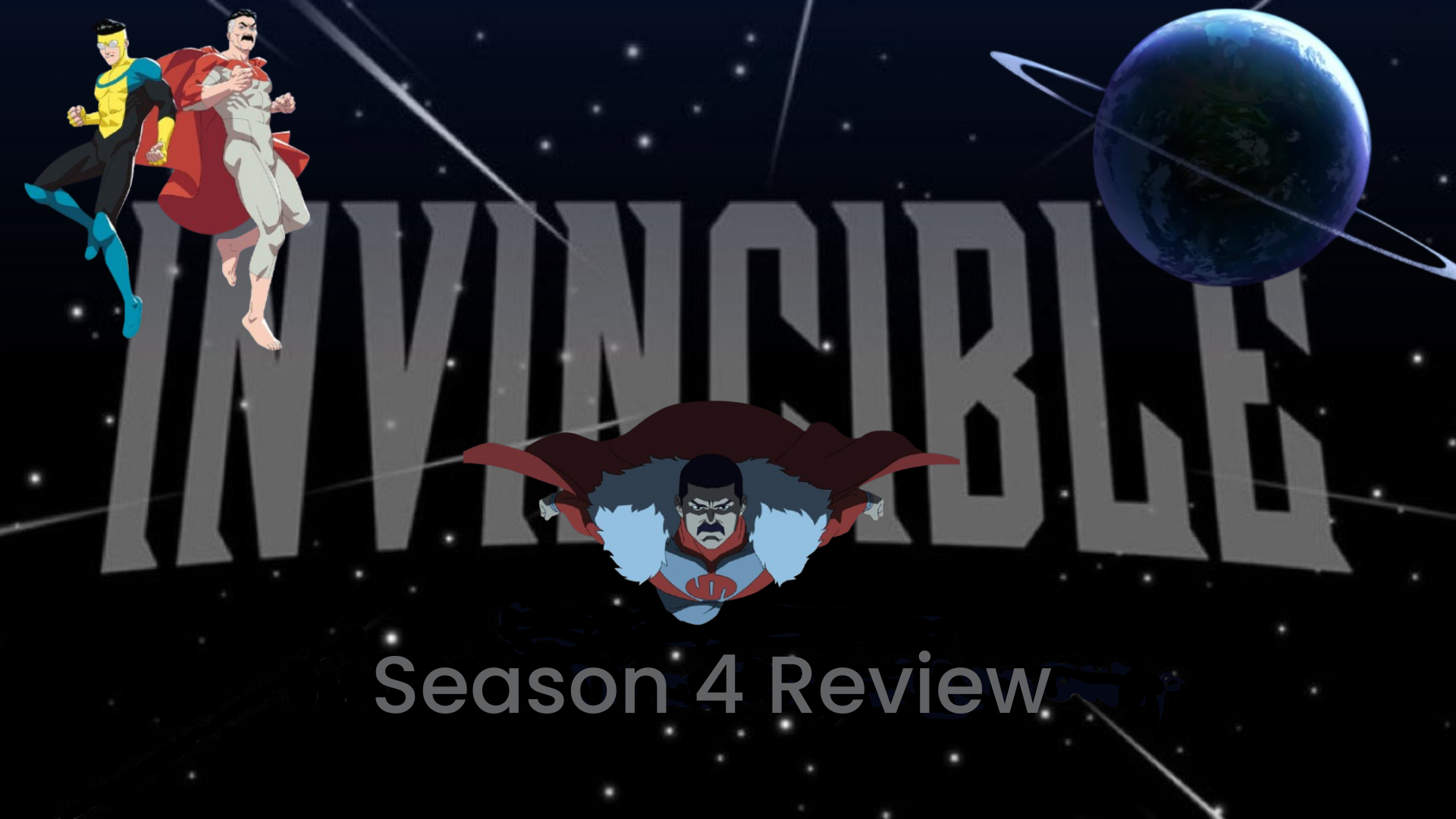
Since its 2021 debut, animated superhero television series “Invincible” has been one of Prime Video’s most successful creative endeavors, both commercially and critically. After a lightning-in-a-bottle first season, concerns about the creative team’s ability to sustain its greatness grew, especially after the rockier second and third seasons.
Turns out, lightning does strike twice.
Season four feels like the culmination of what the prior two seasons had been building up to. In the context of these new adventures, the slower, more setup-driven moments from earlier years now make sense. “Invincible” showcases further subversions of the superhero genre, while also knowing how to play into it when necessary.
The first episode, “Making the World a Better Place,” sees Mark Grayson/Invincible (Steven Yeun) dealing with the aftermath of his victory over Conquest (Jeffrey Dean Morgan). After their climactic battle at the end of season three, Mark is reconsidering his philosophy on killing his enemies, which becomes even more relevant when a possessed astronaut leads a swarm of mind-controlling aliens called Sequids to attack the city.
In one of the show’s tensest moments, Invincible decides to kill the astronaut leading the attack to prevent the spread of the invasion. It pushes him to consider if he’s becoming too similar to his father, Nolan (J. K. Simmons).
The opening episode is a compelling reminder of how the show can leverage the tropes of the genre to create complexities and tension. It’s a brilliant tone-setter that helps remind us of Nolan’s influence on the planet.
The second chapter, “I’ll Give You the Grand Tour,” shifts to Nolan’s experiences in space with Allen the Alien (Seth Rogen). The two spend the episode’s run time searching for weapons and tools to defeat the rest of Nolan’s former Viltrumite allies.
It feels a little out of place, slowing down the momentum left over from episode one with a largely expository episode, but its final scene introduces us to the season’s primary antagonist: Grand Regent Thragg (Lee Pace), leader of the Viltrum Empire.
From his first moment on screen, Thragg commands our attention. Pace plays him with a precision and terrifying calmness that makes his later moments of rage all the more impactful.
Episodes three and four are a bit more filler, but they help Mark process his connection to his father and his decision to kill. Just in time, because at the end of episode four, Nolan arrives with the coalition of planets, and the Viltrumite War is set to begin.
While the first four episodes are largely good, not great, the back half of the season is virtually flawless. Episode five, “Give Us a Moment,” is perhaps the best balance between action and characterization the show has given us yet. Highlighted by a masterfully-performed confrontation between Nolan and his wife, Debbie (Sandra Oh), and another brutal fight between Mark and Conquest, the result walks a beautiful tightrope for one of the series’s best episodes.
The following episode, “You Look Horrible,” slows the action down a bit, focusing on the relationship between Nolan and his other son, Oliver, while Mark recovers from his fight. Meanwhile, Thaedus (Peter Cullen) leads the Coalition of Planets into a full-on war with Viltrum, led by Allen. It’s another brilliant dichotomy, but the best is still to come.
Episode seven, “Don’t Do Anything Rash,” shows us Thragg unleashed. After a staggering defeat, he retreats with his most trusted lieutenants to their home planet, and Thaedus hopes to ambush them there, with the help of a recuperated Mark, Nolan and Oliver.
But then everything goes wrong.
In the span of 40 minutes, Thragg transforms from a vaguely threatening presence to one of the most intimidating forces in any piece of superhero media I’ve ever seen. He truly feels unstoppable in exactly the way a primary antagonist should this early into the narrative. He can eliminate enemies at a glance, tank hits from the most powerful characters in the show, all while only being hit if he wants to.
The finale, “Don’t Leave Me Hanging Here,” serves as more of an epilogue than a climax, but it might be my favorite episode of the season. After 10 months away from home, Mark and Nolan return to Earth to process their defeat at the hands of Thragg and to try to stop the Viltrumites from infiltrating the planet.
Mark’s trauma starts to manifest itself through hallucinations of Thragg killing the people he loves most while he stands powerless to stop it.
Suddenly, the show’s titular character has never felt more vincible.
The season’s ultimate confrontation is a verbal one, where Mark is given a choice to let the Viltrumites stay on Earth and assimilate, or to try to fight them off once and for all, likely losing Earth in the process.
The episode features one of the best moments of the season, as Nolan encounters his former ally Cecil (Walton Goggins), in one of the most well-written scenes of the show.
“Invincible” has always been characterized by strong writing and performances, and season four only solidified that status. In a lesser show, many of the shifting alliances and motivations throughout the narrative could feel rushed or unearned.
Not here.
Every action is motivated by the plot, every decision is consistent with the characterization, and it helps to have an all-star cast delivering the lines along the way.
As usual, the biggest flaw “Invincible” faces is its animation. The style can grow stagnant and monotonous over time, and while it can shine in moments, they are too few and far between. Frankly, Thragg’s greatest power is improving the animation quality whenever he’s on screen.
I’d gladly wait a few extra months for improved animation, but the appeal of “Invincible” has never been a groundbreaking visual style. It was always good writing delivered by great actors that brought in viewers.
If season four is any indication, those viewers have no reason to go anywhere.