
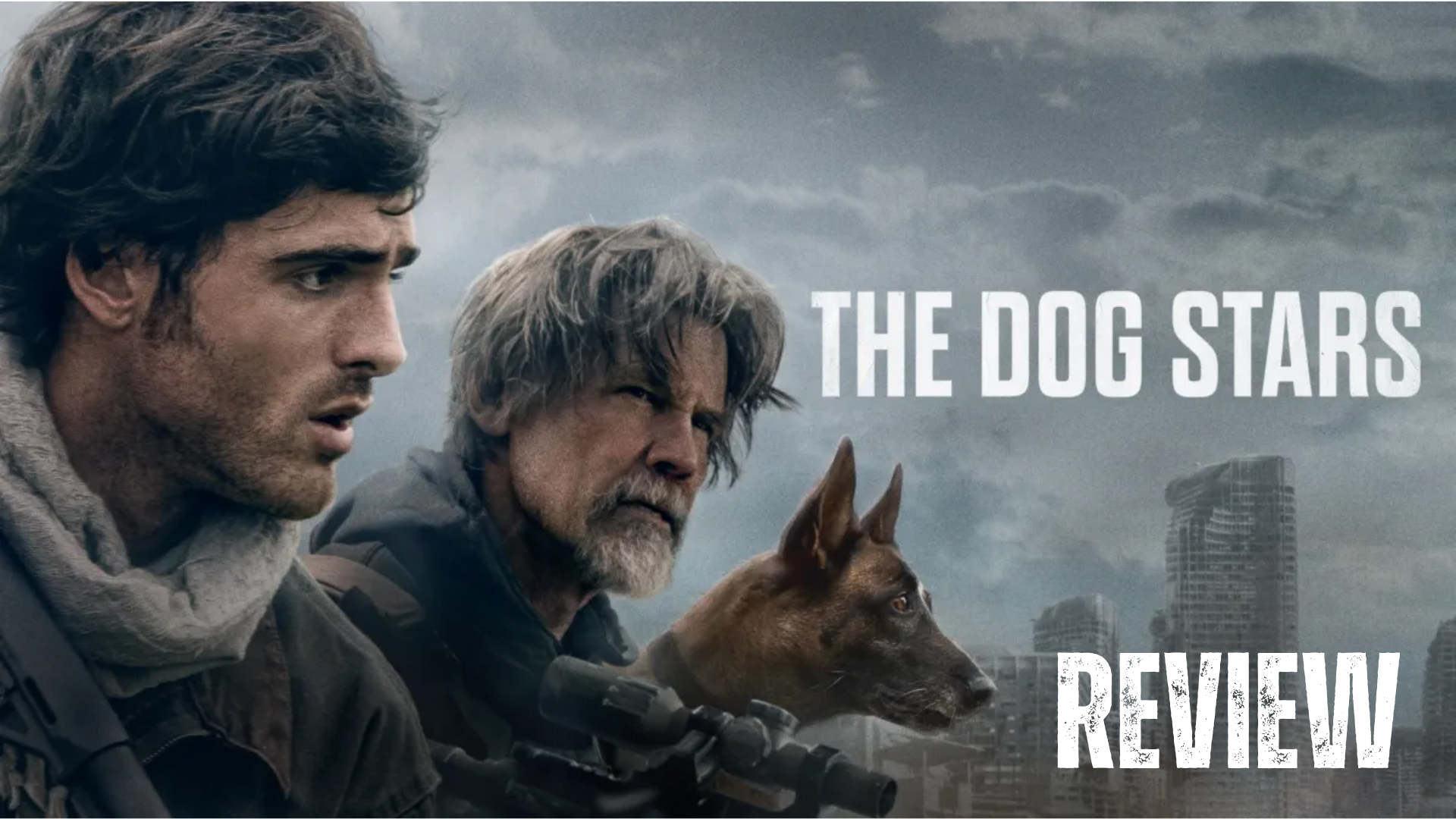
This review contains spoilers for “The Dog Stars” (2026)
In many ways, Ridley Scott’s newest directorial feature feels like a version of the future we could easily be headed toward.
Set in 2035, the film follows a post-apocalyptic world ravaged by a virus that killed most of the human race, leaving few survivors to fend for themselves. It’s a tried and true formula, but in our post-COVID world, it’s especially poignant.
Near the middle of “The Dog Stars,” Cima (Margaret Qualley) tells Hig (Jacob Elordi) that her husband died of the unnamed pathogen on the other side of the country, and she was unable to be with him due to quarantine. In this society, or lack thereof, these characters echo stories that we’ve heard countless times in the past half-decade.
Unfortunately, echoing emotions is about all the characters in this movie do. For a film that’s ostensibly about grief, very little grieving is seen. “The Dog Stars” wants its theme to be one of camaraderie – that, as its tagline states, “no one survives alone.”
But it does a very poor job of showing this to be the case.
Our lead protagonist, Hig, is almost never on his own. His only moments of solitude come when he’s soaring through the forested skies in his yellow Cessna, a time when he’s almost completely out of danger. Otherwise, he’s accompanied by Bangley (Josh Brolin) at their base outside of Denver, or Cima and Pops (Guy Pearce) once he leaves for Grand Junction.
Only Bangley is alone for an extended period of time, and he survives his ordeal with the group of raiders that attempt to sack his residence in the middle of the night. The idea that loneliness is no way to live goes virtually unsupported by the narrative, leaving the film more aimless and confused than anything.
The characters aren’t exactly models of depth either. We know more about what each of them do than who they are. In a different, better script, those traits might be reflections of who the character is.
Hig’s previous life as a mechanic tells us almost nothing about his current state of being in the apocalypse, other than giving an excuse for his competency with vehicles and electronics. We aren’t told what Bangley and Pops did before the outbreak, and we’re more told their character traits by the people around them than shown.
Cima probably turns out the best in this aspect. Her background as a registered nurse explains her willingness to help Hig when he crash-lands in her backyard.
These characters stay almost entirely static throughout the film too. Hig appears to have finally moved past his grief by the end of the movie, but there’s very little indication as to what exactly about his recent experiences has changed him.
Cima starts helpful and ends helpful, never seeming too bothered by her state of affairs.
Bangley’s willingness to be a lone wolf is not only uncritiqued, but vindicated by the plot, making his decision to live in a village with others at the end of the movie seem out of character.
Pops is the only person within the core four that undergoes a natural change, becoming more willing to assist the people around him, despite everyone he encounters other than Hig being transparently or deceptively hostile. It feels like the movie’s two elder statesmen should have had the opposite reactions to their ordeals.
This movie isn’t really about grief or loneliness, because it’s not really about anything at all.
Characterization isn’t the only aspect this film falls flat on.
For the first two acts, “The Dog Stars” is, largely, effectively paced. But the start of the third act opens with Hig, Cima and Pops arriving in Grand Junction to find a functioning, if suspicious, civilization.
Soon enough, the trio discovers that the people within the airport-turned-town have been luring survivors to their new habitation to either breed, work or be eaten. The three then fight their way out before returning to Hig’s old base near Denver.
This is easily the most baffling part of the movie.
The whole affair takes no more than 20 minutes. It plays like nothing else in the film; none of the characters ever act like they’re in real danger once the guns start firing, and the twist comes inexplicably quickly.
To this point, for all its faults, “The Dog Stars” had created a powerful atmosphere, which this set piece completely throws out the window. There’s no foreshadowing for this before the third act, and the whole ordeal feels pointless. It belongs in a different movie, or, perhaps more accurately, no movie at all.
However, despite what the previous paragraphs might lead you to believe, I think “The Dog Stars” is good.
The aforementioned atmosphere is doing most of the heavy lifting here. Despite being set in the future, the dark green forests and overgrown meadows give you the sense that you’re taking a glimpse into the past. The score and soundtrack prominently feature acoustic guitars, creating an air of nostalgia for a time that won’t exist.
At least, not when the movie says it will.
This film has been criticized for being slow, but I think the pacing is more deliberate than meandering. Large, sweeping, scenic shots pad the movie toward the two-hour mark, but there’s far worse ways to pass the time. It’s reminiscent of the calculated, methodical 2025 Best Picture nominee “Train Dreams” in both pace and setting.
Based on the critical and commercial reception to “The Dog Stars,” it will not be receiving that level of awards attention, nor should it. But the similarities are hard to ignore.
For all the script’s faults – and there are many – these actors are doing a hell of a job. Elordi, Qualley, Brolin and Pearce are perpetually likeable, making the most out of their inconsistent characters. Allison Janey is having the time of her life in her limited role as the sinister Darlene. She’s a bright spot in what’s otherwise the worst part of the movie.
But even with all these A-list actors, the real star of the show is director Ridley Scott.
For years, Scott’s trademark has been creating a sense of scale. He makes this story, which never leaves the American west, feel like a globe-trotting adventure. The overhead shots of the plane flying over trees, lakes and clouds are breathtaking. He makes incredibly stylized choices in the action sequences without them ever becoming incoherent or confusing.
For all the problems I have with the actual language of the film, the visual language is impossible to dislike.
As the credits rolled, and I sat in the theater trying to make sense of the confoundingly simple movie I had just watched, I came to a realization: “The Dog Stars” is a haunted film.
The ghost of Hig’s wife appears to him when he enters what was once their home. Cima’s inability to help her husband haunts her every interaction in this hostile world.
This natural beauty the movie takes place within is haunted by the fact that, in so many places like it around the world, that beauty was snuffed out by humanity.
It’s haunted by the implication that, without the near total extinction of the human race, this part of the world likely would have followed suit.
The premise is haunted by the reality of a pandemic that, had its fatality rate been a few percentage points higher, could well have created the very world we fictionalize.
Ridley Scott is haunted by his past greatness, now returning to his groundbreaking “Alien” franchise. This movie’s faults reflect his career. Characters who don’t move forward despite desperately wanting to give the appearance of it.
They’re still searching for closure, like how Scott is still searching for a new story he can use to prove he’s still got the magic touch.
“The Dog Stars” isn’t that movie for Scott. It never was. It’s a perfectly acceptable post-apocalyptic action movie, with a dystopia that actually feels dystopic, characters that feel more like caricatures and very few risks being taken.
But you won’t land among the stars if you never aim for the sky at all.