
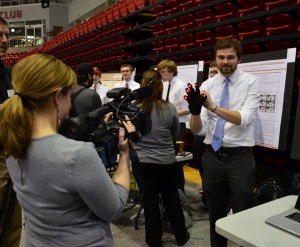
Students showcased their research, scholarships and creative works at the annual Student Scholarship expo last night. However, this year’s expo was different because there was a strong push by the Office of Research and Sponsored Programs to make the expo more multi-disciplinarian.
“Last year, about 80 percent of participants were in science-heavy disciplines,” Sandra Shumaker, executive director of Research and Sponsored Programs, said. “This year, we worked very hard to make the expo open and accessible to all disciplines.”
Shumaker said the office of sponsored programs altered how projects are judged and how awards are given.
“We now have a research and scholarship rubric as well as a creative works rubric for our judges,” Shumaker said. “We also expanded the number of awards each college offers. For example, in the [Slane] College of Communication and Fine Arts, there is an award for communications and an award for fine arts. In the past there was only one award per college.”
Shumaker said she thinks the expo has succeeded in reaching more people from diverse academic backgrounds.
“We have almost double the number of projects we had last year,” Shumaker said. “For the first time we have projects in the fine arts, in music, in family and consumer science and many other disciplines that weren’t represented before.”
According to Shumaker, there were around 195 projects at the expo. One of the new participants was graduate student Alexander Martin.
“I’ve never done the expo before, but my art history professor had one of the organizers talk to my class about it and got me interested,” Martin, a fine arts graduates students, said. “My project [was] rooted in the art world. I created this alternative exhibition space for artists out of a garage with my friend.”
“I’ve been walking around and it has been cool to see something about chemistry in the brain and then something about linguistics in business and then like painting, all of it within inches of each other,” Martin said.
Martin said the judges were very receptive to his project.
“I think the judges like that my project is more visual and less technical,” Martin said. “It gives them something interesting to look at and interact with. The judges are also geared towards your subject. For example, one of my judges was a painter.”
Not all of the participants had such a positive experience.
“My project is about traditional Chinese views on mental illness,” sophomore psychology major Veronica George said. “I haven’t felt very welcomed at the expo because it seems more focused on the hard sciences and math side of things.”
George said she felt brushed off by the judges.
“I was judged by two bankers and a professor of international business,” George said. “They asked some good questions, but they didn’t seem very interested.”
Despite this negative experience, George said she would definitely participate the expo again.
Shumaker said she was receptive to student feedback.
“Next week, all of the student participants will receive a survey from us asking for feedback,” Shumaker said. “We’re always open to ideas and suggestions, and we’re constantly striving to improve the expo. A lot of the changes that happened this year are the result of student feedback.”